Vending machine locations are the specific places where machines are installed and operated, and their value can change over time as foot traffic, customer routines, and the surrounding business mix change. For vending operators and business owners managing routes, finding a strong location is only part of the job. Once a machine is established and producing consistent sales, there is usually little reason to reconsider its placement—until the location itself starts to shift. An office that once had 150 employees may introduce hybrid work. A factory may reduce its shifts. A building may change tenants. A new convenience store or café may open nearby. The number of people at a location may stay roughly the same while their buying habits change.
That is why existing vending machine locations need regular review. This article focuses on how to spot an underperforming location, read sales trends correctly, compare revenue with actual profitability, account for service frequency and opportunity cost, and judge whether outside changes are hurting performance. It also looks at when product and price adjustments are no longer enough, when relocation becomes the better decision, and how management software can help you review locations more consistently.
Start with the sales trend
A single slow month usually does not tell you much. Sales can fluctuate because of holidays, seasonal changes, temporary closures, vacations, weather, or changes in working schedules. It is more useful to look for a sustained trend.
For example, if monthly sales move from $820 → $790 → $755 → $710 → $680 → $640, there may not be one month that looks particularly alarming. Over six months, however, the direction is clear. This type of gradual decline can be easy to overlook because operators become accustomed to the new level of sales as it develops.
Comparing longer periods helps provide context. Look at the last three or six months against the preceding period and, where the business is seasonal, compare the same months across different years. The important question is not whether sales occasionally fall. It is whether the location appears to be settling at a permanently lower level.
Make sure the property owners and location are actually the problem
Before considering relocation, check the factors you can control. Poor sales can result from a machine that is badly stocked just as easily as from a poor location.
Check whether popular products are frequently out of stock. Look for selections that have stopped working correctly. Review your prices. Consider whether the assortment still suits the customers at that location. Make sure cashless payments are working reliably if the machine accepts them. Product-level sales can be particularly useful here. If overall sales are falling but several previously popular products have repeatedly been unavailable, the location may still have plenty of demand. The problem is inventory management.
Similarly, a machine filled with products that perform well elsewhere may simply have the wrong assortment for this particular customer base. Before moving a machine, it makes sense to test reasonable changes to the product mix, pricing, and stocking levels and see whether performance improves.
Revenue alone doesn’t tell you whether a vending machine location is good
Operators can also make the mistake of judging locations entirely by revenue. Consider two machines that each generate $500 per month. One is located close to several other machines on an existing route and needs to be serviced twice a month. The other requires a substantial detour, needs weekly service, pays a commission to the location, and regularly requires additional visits. Although their revenue is identical, their contribution to the business is not.
A location has costs beyond the products sold there. Depending on the operation, these can include fuel, labor, card processing fees, commissions, maintenance, spoilage, and the time required to service the machine. That means a relatively high-revenue location can still be less attractive than a lower-revenue machine that is inexpensive and convenient to service. For this reason, operators should evaluate location profitability rather than sales alone.
Consider what has changed around the machine placement
If the machine itself appears to be operating well, look at the location. A decline in vending sales often has a practical explanation. An employer may have fewer people working on site. A university building may be used differently. A warehouse may have changed its shift structure. A hospital department may have moved. A company may have started providing free snacks.
Competition can change as well. A new café, convenience store, cafeteria, food truck, or another vending machine can give customers alternatives that did not exist when the machine was originally installed. This is particularly relevant for older accounts. The conditions that made a location attractive when the machine was placed may no longer exist several years later.
Talking to the location manager can sometimes explain a sales decline faster than analyzing the machine itself. A simple question about staffing levels, schedules, or recent changes in the building may provide useful context.
Foot traffic is not the same as vending demand
High foot traffic is often used as an indicator of a promising vending location, but not every location with heavy traffic is one of the right locations, and the number of people pass a machine is only part of the picture. Operators should evaluate different types of traffic instead of assuming the busiest areas are the best places. Common vending locations include schools, gyms, and hotels, but the best locations depend on how people use the space.
A machine in a busy lobby may be passed by hundreds of people who spend very little time there. A machine in a workplace with far fewer people may have customers who remain on site for eight-hour shifts and purchase several times each week. Gyms and fitness centers can work well because vending machines there cater to health-conscious consumers and often sell healthier options and sports drinks. The second location can easily produce better vending sales despite having much lower overall traffic.
When evaluating a declining location, consider whether the type of traffic has changed. Are people spending less time there? Are employees working shorter or different shifts? Has a waiting area become a passageway? Are fewer people taking breaks near the machine? Airports and train stations, government buildings and public libraries, and manufacturing facilities or warehouses can all draw heavy traffic, but volume alone is not enough unless that traffic converts into purchases. These changes may not be obvious from the number of people entering the building, but they can materially affect vending demand.
Look at the location in the context of your route
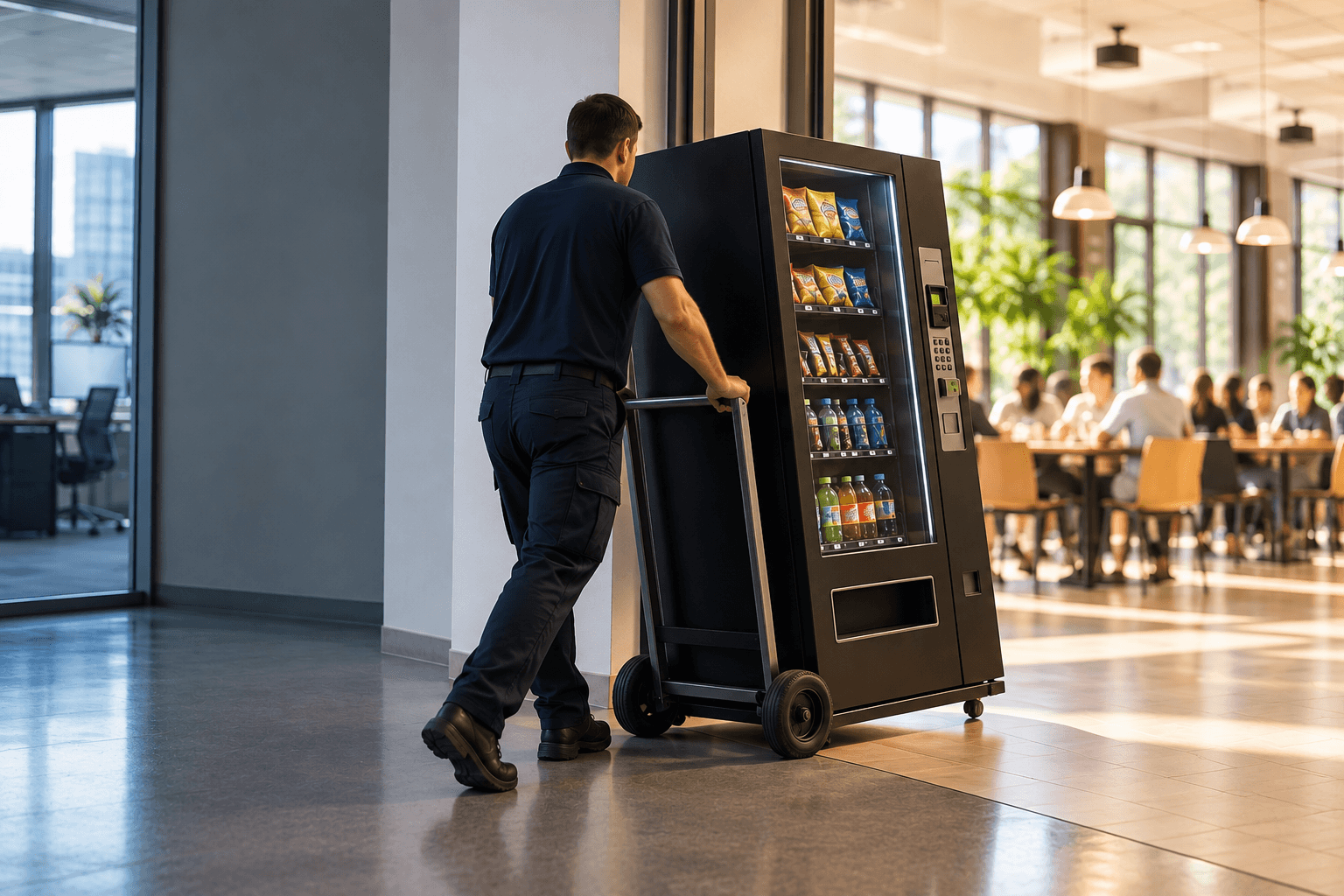
A vending machine does not operate independently from the rest of the business. Its location affects how efficiently the entire route can be serviced. A moderately performing machine that is two minutes away from another stop may be worth keeping. The same machine located 30 minutes away from the rest of the route may not be.
This becomes increasingly important as an operation grows. Adding locations that are geographically close to existing accounts can increase route density and allow more machines to be serviced in the same amount of time. Operators can use Google Maps and similar tools to research potential vending machine locations, identify new locations, and cluster more locations efficiently by city or area. Conversely, isolated machines still add significant travel for relatively little additional revenue.
When reviewing a location, it therefore makes sense to consider both the machine’s individual performance and its place within the wider route. A machine can technically be profitable while still being an inefficient use of operating time.
Watch how often you’re visiting relative to what you’re selling
Service frequency can reveal another type of underperforming location. If a machine requires frequent visits but generates relatively little revenue, the operator may be spending too much time servicing it relative to its value. The opposite can also happen. A machine with moderate sales but very predictable demand may require little attention and fit efficiently into the route.
This is why sales per machine should ideally be considered alongside servicing requirements. Operators can also review whether the current service schedule itself needs adjusting. A machine whose sales have declined may no longer need to be visited as frequently as it once did. Reducing unnecessary visits may improve the economics enough to justify keeping the location.
Separate seasonal declines from permanent ones
Not every long decline indicates a problem. Schools and universities have predictable quiet periods. Some offices empty during summer and holidays. Manufacturing businesses may have seasonal staffing patterns. Tourist locations can vary dramatically throughout the year.
If a machine performs poorly every July but recovers every September, moving it in August would obviously be premature. Historical data becomes particularly valuable here. Instead of comparing July with June, compare this July with previous Julys. If the machine normally generates $700 during that month and has fallen to $400 this year, the change is more meaningful. Without that historical context, normal seasonality can easily be mistaken for deteriorating performance.
Decide how long an improvement test should run
One practical way to evaluate a questionable location is to give it a defined review period. Rather than repeatedly making small changes without a clear decision point, choose a period during which you will test improvements.
You might adjust the product mix, correct stockout problems, review pricing, change the service frequency, or speak with the location about changes in customer traffic. Then monitor the results for an appropriate period. The exact length will depend on the location, but the principle is useful: set a point at which you will review the results rather than continuing indefinitely.
If sales recover, the location may still be worthwhile. If they do not, you have stronger evidence that the problem is not something that can easily be corrected through normal machine management.
Consider the opportunity cost of the machine
There is another factor that can be overlooked when deciding whether to keep a weak location. The machine itself has value. If it remains at an underperforming account, it cannot simultaneously be placed somewhere with greater demand.
This is particularly relevant for operators who already have potential locations available or who are trying to expand without purchasing additional equipment. Suppose a machine is producing a small positive return at its current location. On paper, there may be no obvious reason to remove it. But if a substantially stronger location becomes available, a vending operator can secure new placements through direct outreach to local businesses, property owners, and the business owner who acts as the decision maker. An in-person walk and visit are often the right approach and work better than cold calls because they improve access to the right person and can open the door to stronger sites. To place vending machines, bring simple printed materials such as brochures and sample agreements, explain your vending service and how it differs from other vending providers, and start building rapport for longer-term machine placement.
The decision is therefore not always between a profitable machine and no machine. It may be between the return generated by the current location and the return that the same equipment could generate elsewhere.
Use data to review vending business locations periodically
Location performance is easier to evaluate when sales information is stored consistently over time. With vending management software such as VendSoft, operators can review sales across machines, locations, products, and different time periods. This makes it easier to identify sustained declines, compare locations, and distinguish a product problem from a broader change in machine performance.
That does not mean every decline requires intervention. The purpose is simply to notice changes early enough to investigate them. A useful location review can include sales trends, product performance, service frequency, commissions and expenses, route efficiency, known changes at the site, whether the vending service is supporting customer satisfaction there, and the potential value of placing the machine elsewhere.
When does moving the machine make sense?
There is no single revenue threshold that determines when a vending machine should be relocated. A reasonable level of sales for one operator may be unacceptable for another because costs, route structure, commissions, and servicing requirements differ.
The decision becomes clearer when several factors occur together: sales have declined consistently rather than temporarily; equipment and payment issues have been ruled out; reasonable changes to the assortment and pricing have not improved performance; the customer population or surrounding environment has changed; and servicing the location produces a relatively poor return compared with other stops.
At that point, relocating the machine becomes a straightforward allocation decision. Operators regularly review which products deserve space inside a machine, and it makes sense to apply the same principle to the machines themselves. A location should continue to justify the equipment, inventory, travel, and servicing time allocated to it. When it no longer does, moving the machine may be more effective than continuing to optimize a location whose underlying demand has changed.
See how VendSoft can help you track and compare the performance of your vending locations. Start your free 14-day VendSoft trial— no payment info required.
Want more vending business tips?
Subscribe to our free 2-week email course and learn how to start a successful vending business.