Hospitals are one of the few locations that run true 24/7 — not “long hours” like a gym, not gated by a bell schedule like a school, but round-the-clock with no real off-peak window. What makes them uniquely complex for an operator isn’t the hours, though — it’s that a single building holds three completely different buyer groups: staff working night shifts, patients with restricted diets and low appetites, and stressed visitors killing time in a waiting room. Getting a hospital placement right means planning for all three, not just one.
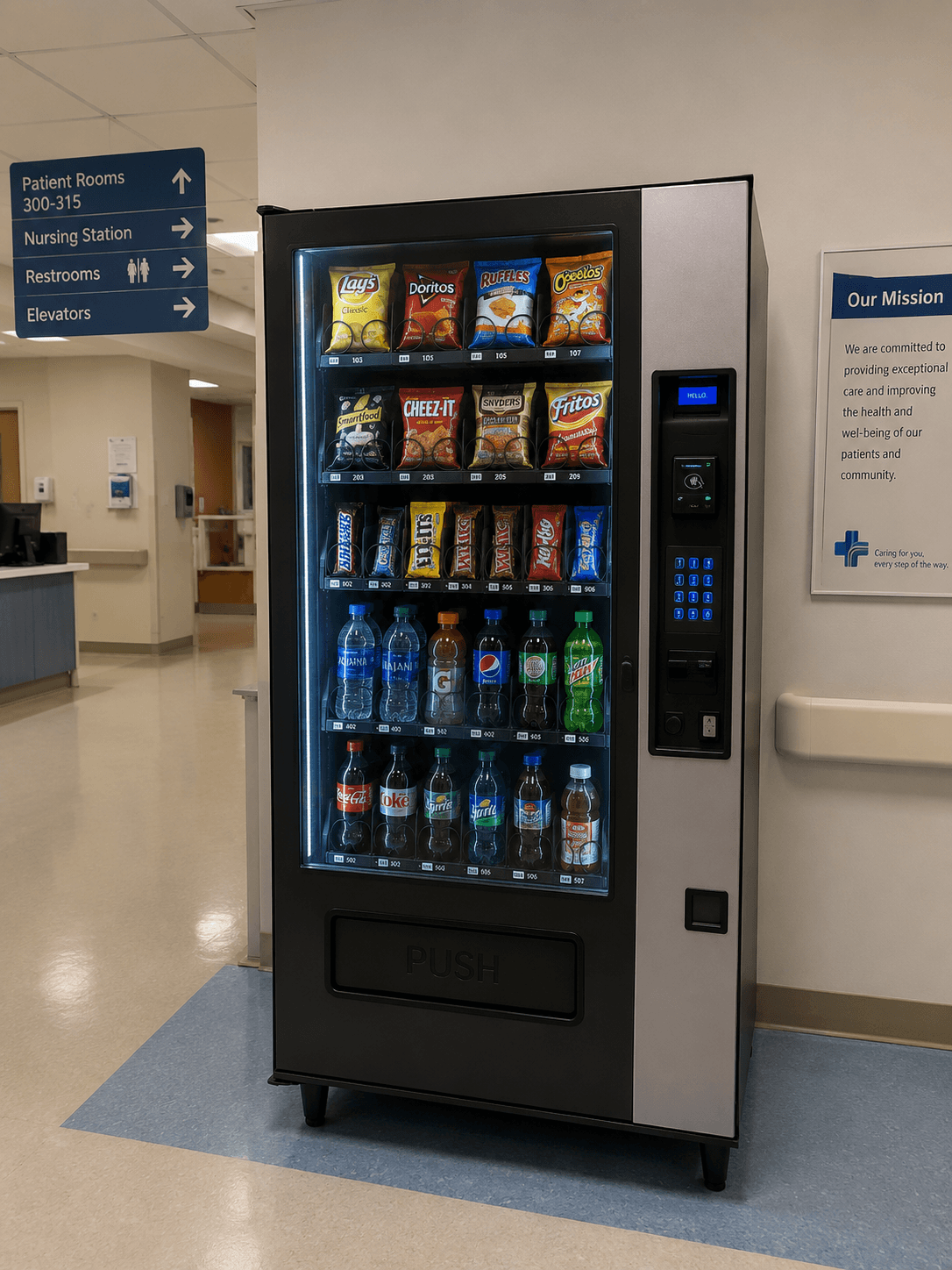
Why Hospitals Work as a Location for Hospital Vending Machines
Most locations in this series have a rhythm: offices empty out at 6pm, gyms spike at 6am and 6pm, schools shut down on weekends. Hospitals don’t have that rhythm. Emergency departments, ICUs, labor and delivery, and night-shift nursing staff mean there’s meaningful foot traffic at 3am just as there is at 3pm. These locations operate around the clock, which supports hospital staff and medical staff through long shifts. For an operator, that’s about as close to guaranteed, non-stop demand as a location type gets — there’s no “closed” sign to plan around.
But that constant demand comes with a catch that doesn’t show up in offices, gyms, or schools: a hospital isn’t one audience, it’s three, often in the same footprint.
Staff — nurses, techs, and support staff working 12-hour shifts, frequently overnight, who often can’t leave the floor when cafeteria or other food service options are unavailable. They need fast, filling, dependable options and they need the machine to actually be stocked when they get five minutes to grab something. That kind of quick access supports staff wellness and well being during demanding shifts. In practice, that means snacks, drinks, and even meals matter most when people need something reliable between tasks.
Patients — a much more sensitive group. Many are on restricted diets, recovering from procedures, or simply not very hungry. Vending near patient-facing areas has to be thought through differently than a break room mix; this isn’t the place for the biggest bag of chips on the rack.
Visitors and family — often in a waiting room during one of the more stressful moments of their week. This group tends to buy on impulse and for comfort, and access to familiar items can also help loved ones in stressful moments: coffee, a candy bar, something to do with their hands while they wait for news. It’s convenience-driven, emotionally-driven purchasing, and it behaves more like an airport terminal than an office break room.
That three-way split is the core planning signal that separates hospitals from every other location in this series, especially because better zoning can support patient care and improve patient satisfaction. In an office, gym, or school, you’re generally building one consistent product mix for one relatively uniform audience. In a hospital, you may be building two or three different mixes for two or three different zones — staff break rooms, patient floors, visitor waiting areas, and the ER — all under one roof, sometimes even under one contract.
If you’re mapping out whether a hospital is worth pursuing relative to other location types, it helps to see the qualifying criteria side by side rather than working it out placement by placement.
Product Mix and Machine Type Guidance for Healthcare Facilities
Because hospital vending machines serve multiple zones with different needs, the product strategy should be zone-specific rather than one-size-fits-all.
Visitor and waiting-area zones should lean into comfort and convenience. This is where coffee machines, a convenient snack, and bottled water earn their keep — visitors are often not thinking carefully about nutrition in the moment, they’re thinking about staying awake, staying comfortable, and having something to do while they wait. A combo of hot beverage vending and a straightforward snack machine tends to outperform anything more complicated in these areas.
Patient-facing zones call for a lighter touch. Where vending is placed near patient areas at all, healthier choices are generally more appropriate — think baked chips over fried, healthy snacks, protein bars, and low sugar drinks over full-sugar soda, with healthier options and smaller portion sizes. This isn’t about eliminating indulgent snacks everywhere in the building; it’s about being thoughtful in the specific zones where patients themselves are the likely buyer.
Staff break rooms and night-shift areas are the opposite problem: durability and always-on availability matter more than variety. Staff working overnight need the machine to be reliably stocked with filling, shelf-stable options, and placement near break rooms or nursing stations can provide reliable access for doctors and nurses who cannot step away — because for a nurse on a 2am break, “the machine was empty” isn’t a minor inconvenience, it’s a missed meal.
Across all three zones, hygiene and sanitation expectations run higher than what you’d plan for in a typical office or gym. Touchless payment options and machine surfaces that are easy to wipe down are worth prioritizing in healthcare settings and healthcare environments because of strict health and safety expectations — infection control is simply a bigger consideration here than it is in a corporate break room, and facilities teams will notice if you haven’t thought about it.
Some clinics and outpatient clinics may use different vending solutions, including modern vending machines or micro markets, depending on space and audience needs.
The throughline across all of this: while an office, gym, or school placement is usually one machine, one mix, one audience, a hospital placement is often several machines, several mixes, one building. Plan the proposal accordingly, since tailored vending services can improve access across many healthcare facilities.
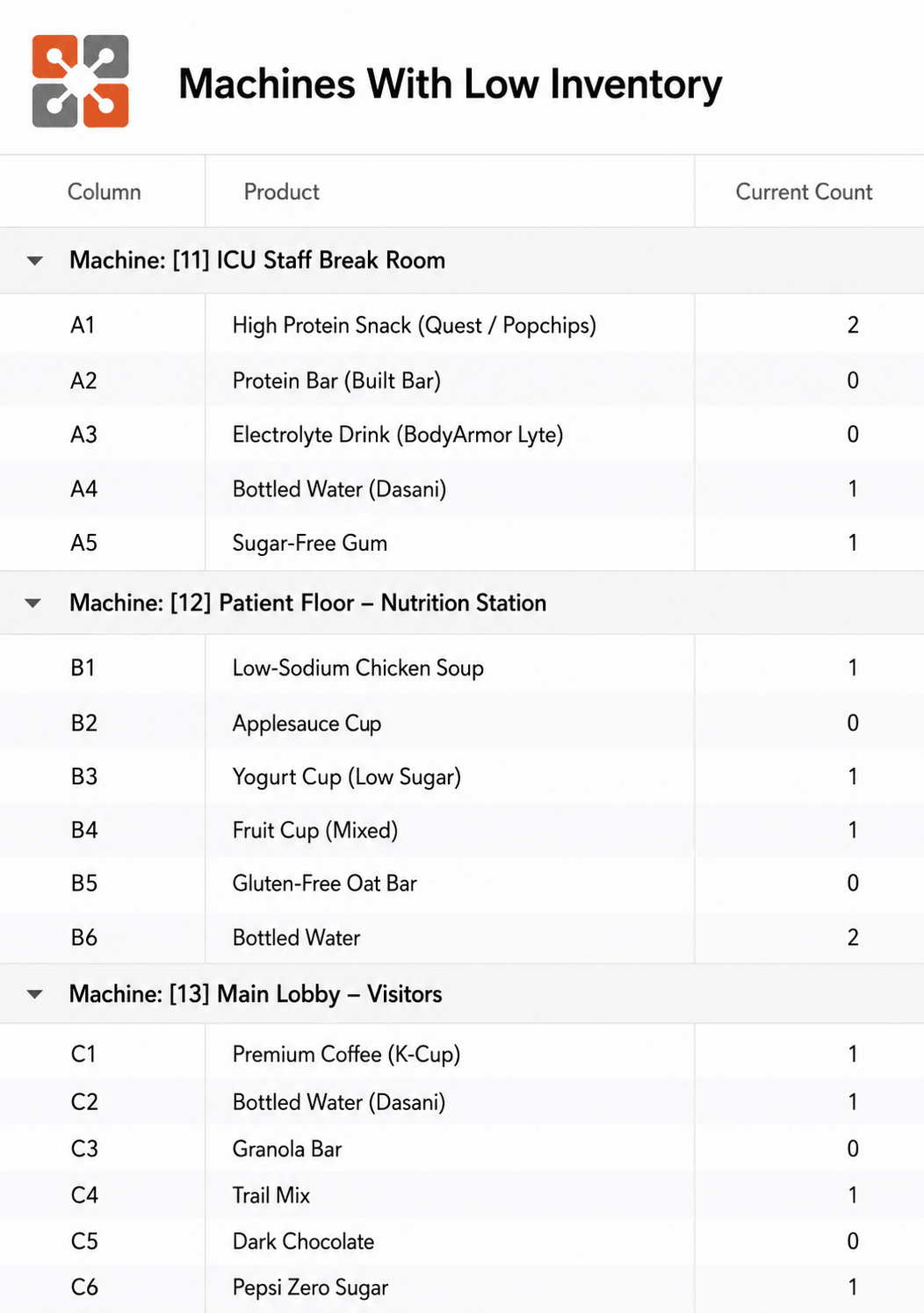
Because uptime matters even more here than in the rest of this series — more on that below — it’s worth showing a facilities contact exactly how you’ll know if a machine goes down or runs empty before they do.
How to Pitch Hospital Administrators
Pitching a hospital is a different process than pitching a single office manager or gym owner, and it’s worth going in with the right expectations.
You’re rarely talking to one decision-maker. Hospitals typically route vending decisions through facilities management or a procurement/purchasing department, and the approval process tends to be longer and more formal than what you’d see with a small business. Expect a proper vendor vetting process, a written contract, and — depending on the facility — insurance or liability documentation before anything gets installed. This isn’t a handshake deal closed in one meeting; budget for a longer sales cycle and come prepared with paperwork, not just a verbal pitch, since in most cases these on site vending machines are managed, restocked, and serviced by the operator rather than hospital staff.
What works in your favor is the pitch itself: vending is a zero-cost amenity for the facility. You’re not asking them to spend money — you’re offering a service that benefits staff, patients, and visitors at no cost to the hospital, while generating commission revenue for them. Frame the conversation around convenience and amenity value for all three audiences, allowing patients and visitors convenient access to snacks and drinks within the broader care environment; when the mix includes healthier options, it can also support wellness initiatives.
The other thing to lead with is reliability, because it matters more here than almost anywhere else in this series. A broken or empty machine in an office is an annoyance someone mentions at the next team meeting. A broken or empty machine in a hospital means reliable access matters when machines serve staff through overnight hours, whether that’s an overnight nurse missing her only break-room meal or a family member waiting on surgery news who couldn’t get a coffee at 4am. Hospitals have essentially zero tolerance for vending downtime, and making that point — with a plan to back it up — is one of the strongest things you can bring to a procurement conversation.
→ Download the Hospital Vending Pitch Template — a formal, facilities-management-ready proposal template built for the longer approval process healthcare facilities require, covering the amenity-value framing, service-level commitments, and documentation admins typically ask for.
Where Hospitals Fit in Your Location Strategy
Hospitals belong in the same evaluation process as the other high-potential locations covered in our pillar guide, Profitable Vending Machine Locations: 2026 Guide — but they’re the location type where the “one audience, one mix” approach breaks down fastest.
Seeing the four side by side makes it easier to spot which of your prospective locations actually need a multi-zone strategy and which can run on a single, consistent mix.
The Bottom Line
Hospitals offer something few other locations can: genuinely constant demand, day and night, with no real closed hours. The tradeoff is complexity — three distinct buyer groups, multiple zones, a longer sales process, and the least room for error of any location type in this series if a machine goes down or runs dry.
Ready to see how remote monitoring works for a multi-zone location like a hospital? Explore VendSoft’s uptime and inventory alerting features →
Want more vending business tips?
Subscribe to our free 2-week email course and learn how to start a successful vending business.