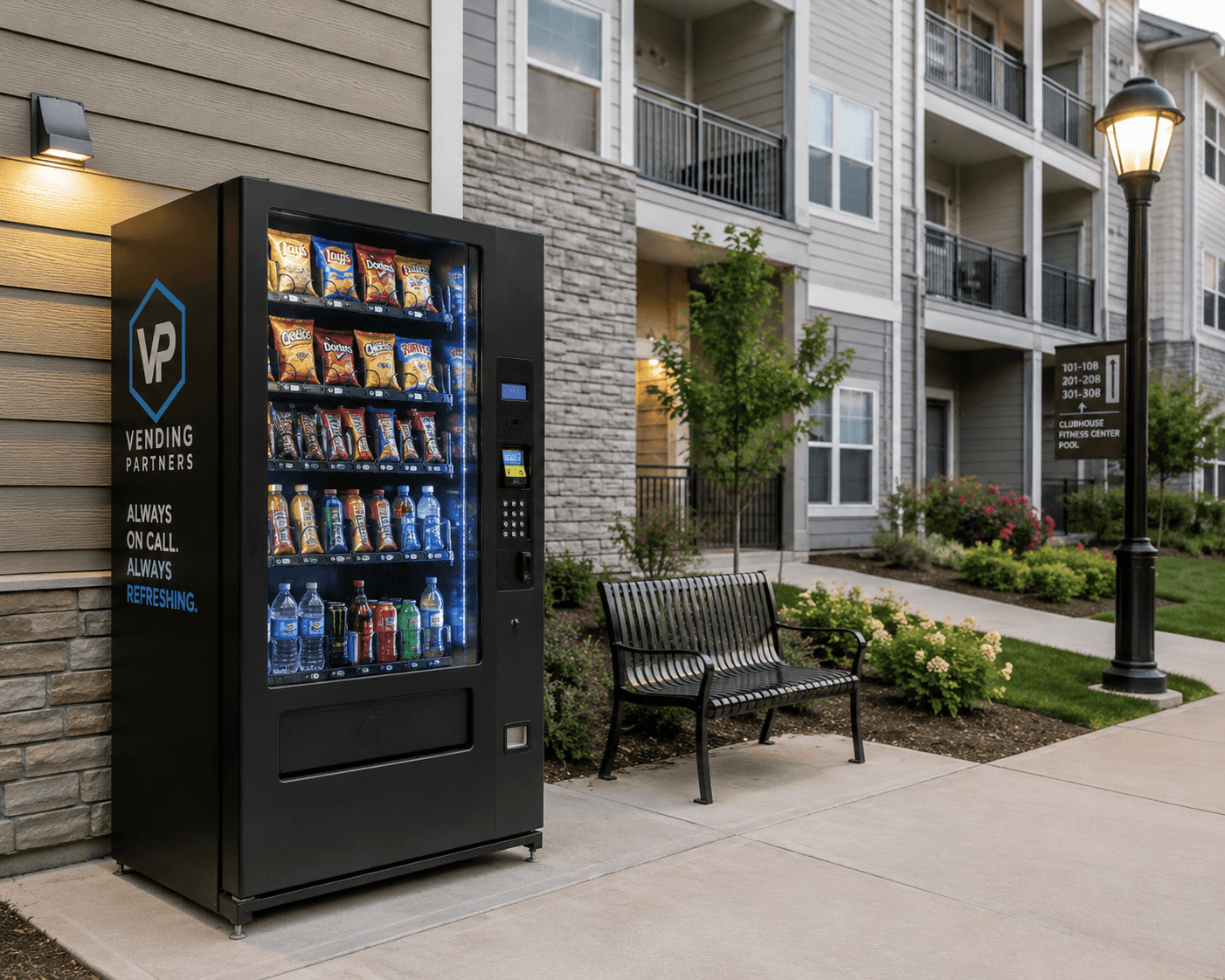
Apartment complexes aren’t a high-volume vending location, but vending machines in apartments residential complexes can produce steady, low-maintenance income by serving a captive audience 24 hours a day. Unlike offices, gyms, and schools, residential properties capture off-hours purchases for snacks and basic essentials residents want on-site, which also makes vending a practical amenity that supports resident convenience and satisfaction. The tradeoff is fewer total transactions and a purchase pattern built around convenience and late-night demand rather than routine daily foot traffic.
For vending machine operators and owners evaluating apartment communities for their route—or already servicing them—the key is knowing when a property is large enough to work, where machines should go, what product mix and machine type fit a residential setting, how to approach property managers and HOAs, and why remote monitoring matters. Treated that way, apartment placements become a reliable addition to a vending route rather than a volume play.
Why apartments work for the vending machine business — and where they don’t
The single biggest variable in whether an apartment complex is worth pursuing is unit count. A 40-unit building simply doesn’t generate enough consistent purchases to justify a machine, restocking trips, or the property’s floor space. As a rule of thumb, operators should be targeting complexes of 150+ units, and ideally 200 or more, especially if the property has a single centralized common area rather than several small buildings spread across a lot. Below that threshold, the math rarely works — you’re better off looking at offices or gyms in the same market.
What makes the math work at larger properties isn’t foot traffic in the traditional sense — it’s access. Unlike an office that empties out at 6 PM, a gym with defined hours, or a school that’s closed nights and weekends, residents are home around the clock. That includes the 11 PM–4 AM window when someone gets back from a late shift, finishes a study session, or just wants a snack and has no nearby convenience store or delivery option worth the wait. This 24/7 access advantage is the core qualifying signal for apartment locations — it’s the reason a lower-traffic property can still produce reliable revenue: the machine is capturing purchases that would otherwise go nowhere, not competing with a kitchen down the hall or a cafeteria across campus. That effect is even stronger when resident demand is shaped by limited transportation or by not wanting to leave the property late at night, which gives machines a more dependable base of repeat customers.
Within a qualifying property, placement matters, and high-traffic shared public areas generally produce better usage than isolated spots. The three spots that consistently perform are:
- Leasing office — steady daytime visibility from prospective tenants, current residents handling paperwork, and staff who become informal advocates for the machine.
- Laundry room — one of the strongest apartment vending spots. Residents are a captive audience for 30–60 minutes at a time, often without their wallet fully stocked for anything more than a quick purchase, which makes a laundry room vending machine a natural fit for snacks, drinks, and laundry-adjacent items like dryer sheets or stain-remover pens.
- Common areas / clubhouse — works well in complexes with a pool, fitness room, or resident lounge, where people are already lingering.
Just be careful not to place a machine where compressor noise or repeated late-night use could disturb nearby residents.
Avoid mailroom-only placements (too transient, no dwell time) and any spot without clear line-of-sight from a staffed area or camera — which matters more here than in office or gym settings, for reasons covered below.
Product Mix and Combo Vending Machine Type
Apartment vending skews toward convenience and “I forgot to buy this” purchases rather than the routine daily snacking you’d design around in an office break room, though the right mix can still include indulgent items alongside healthier choices through healthy vending machines. The mix that performs best combines:
- Late-night snacking and grab-and-go items: snack machines stocked with chips, candy, packaged bakery items, nuts, and even cut fruit can do well, and in some buildings residents also buy small groceries or other fresh options during evening and overnight hours rather than a mid-morning or lunch rush.
- Basic beverages: water, soda, and energy drinks remain steady sellers, though drink vending machines can also broaden the refreshment mix without the health-forward skew you’d stock for a gym audience.
- Household and personal essentials: this is where apartment vending differentiates itself from every other location type in the cluster. Laundry detergent and personal care items are recurring sellers, and bottled water plus phone chargers also work as emergency supplies when stores are closed. A combo vending machine — snacks and drinks on one side, a small locker-style or spiral-tray section for essentials on the other — tends to outperform a straight snack-and-soda unit in this setting, and many newer units support cashless payment when residents do not have bills or coins on hand.
A coffee vending machine can also work in larger properties because it dispenses freshly brewed coffee and fits residents’ morning routines, especially near leasing offices or clubhouses.
This is a meaningfully different mix than what works in the other cluster locations: offices lean toward coffee, better-for-you snacks, and lunch-hour convenience; gyms lean protein bars, sports drinks, and recovery items; schools are constrained by nutrition guidelines and skew toward compliant snacks and beverages. Apartments are the one location type where “things you’d normally drive to a pharmacy for at 1 AM” is a legitimate, profitable category.
How to Pitch Extra Income to Property Managers and HOAs
The buyer here is different from the other three location types. You’re not pitching a facilities manager, an operations lead, or a school administrator — you’re pitching a property manager, leasing office lead, or HOA board, and their motivations are correspondingly different:
- Resident amenity value. Property managers care about tenant retention and how the property shows during leasing tours. Frame the machine as an amenity that costs the property nothing and reflects well during walkthroughs — not as “vending machine,” but as “24-hour resident convenience.”
- Passive income for ownership. Many property management companies and HOAs are receptive to a commission arrangement, since it’s revenue with zero labor or inventory risk on their end. Lead with the amenity angle, then mention the revenue share as a secondary benefit — leasing offices respond better to “this helps with retention” than to “this makes you money,” even when the latter is also true.
- Security and liability. This is the concern you need to raise before they do. Laundry rooms, clubhouses, and common areas are typically less supervised than an office break room or a gym floor — no receptionist, no front desk, often no staff on-site after hours. Property managers will worry about vandalism, theft, and liability for anyone loitering near the machine. Address this proactively: point to a well-lit, camera-covered location as a placement requirement, mention that modern machines log every transaction and door-open event, and note that remote monitoring means you’ll often catch and respond to a problem before the property even knows it happened. Bringing this up unprompted signals that you’ve thought about their property, not just your revenue.
A short, specific pitch — unit count check, proposed placement, revenue share, and a one-line answer to the security question — will get further with this audience than a general sales deck built for an office or gym.
Next Steps for Vending Equipment
Apartment complexes are a solid addition to a route once you’ve already got denser, higher-traffic locations anchoring your income — they’re steady rather than spectacular, and the 24/7 access advantage is what makes the math work despite lower daily volume.
The U.S. vending machine industry generated $18.2 billion in 2023, with roughly 3 million machines in operation, which helps explain why operators keep refining vending equipment and technology for residential settings.
For the full picture of how apartment locations fit into a broader placement strategy, see our guide, Profitable Vending Machine Locations: 2026 Guide.
Because apartment placements typically get less day-to-day oversight than a staffed break room, remote visibility matters more here, not less. VendSoft’s remote monitoring gives you real-time alerts on stock levels, cash and card activity, so a laundry-room or clubhouse unit doesn’t need a daily drive-by to stay stocked and secure. You can start your 14-day free trial here (no payment info required!).
Want more vending business tips?
Subscribe to our free 2-week email course and learn how to start a successful vending business.