A vending machine franchise is a way to enter the vending business by buying into an established system that provides training, operating processes, and often help finding locations in exchange for an upfront franchise fee and an ongoing royalty on your revenue. Going independent costs less to start and lets you keep 100% of your profit, but you’re responsible for building every part of the business yourself, from sourcing machines to landing locations. Neither path is objectively better — the right one depends on how much structure you want and how much margin you’re willing to trade for it.
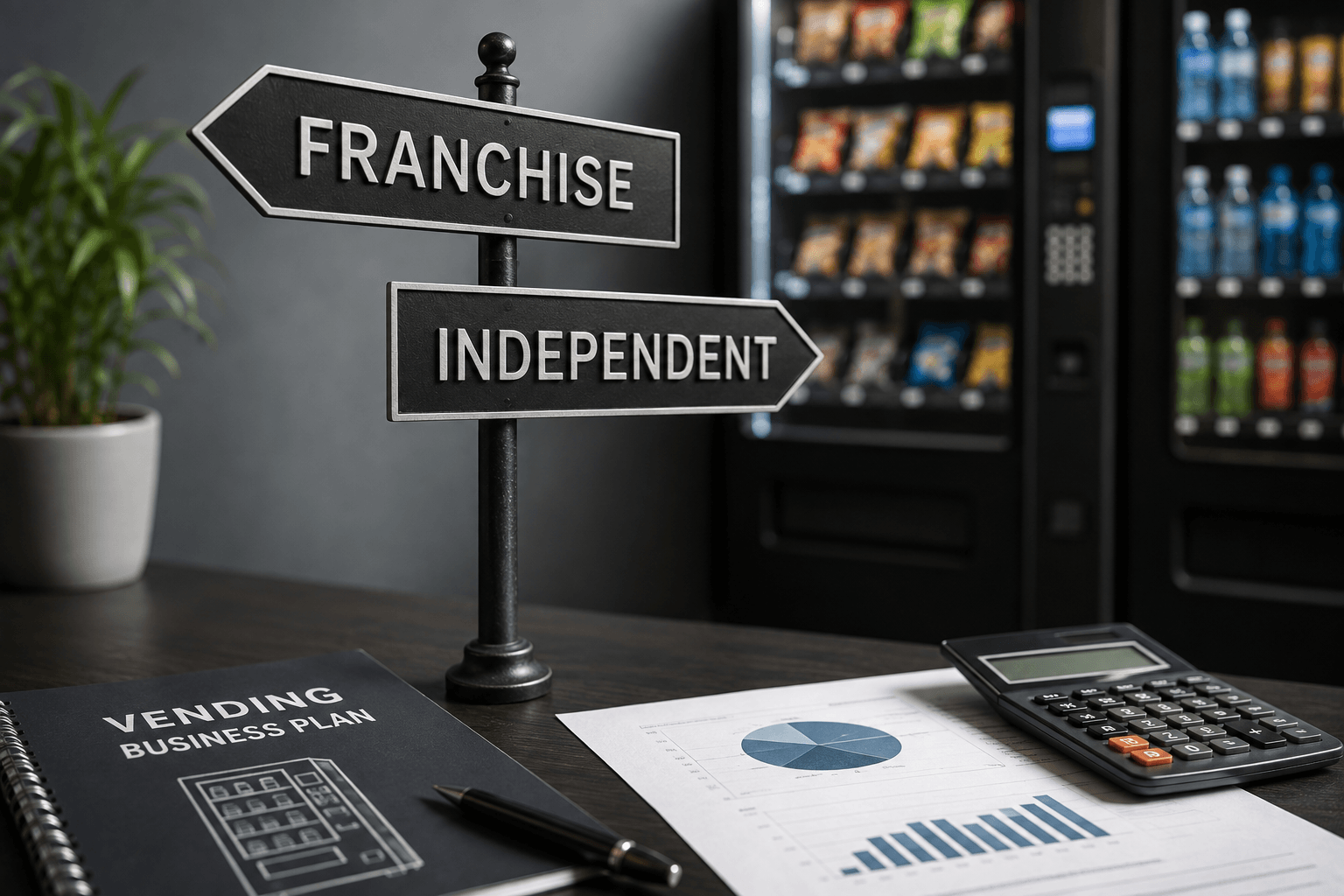
If you’re at the very start of deciding how to get into vending, this is the fork in the road that matters most. Your choice affects startup costs, profit margins, how the business is structured, and how easily you can grow over time. This breakdown is for anyone weighing franchising against the independent route, and it walks through what a vending machine franchise includes, the costs and tradeoffs on both sides, the day-to-day realities of running machines, and how to decide which path fits you.
What vending machine franchises actually include
When people picture a vending franchise, they’re usually thinking of systems like Healthy You Vending or similar branded operations: a company that has already worked out the machine specs, the product mix, the placement pitch, and the training curriculum, and sells you the right to run that playbook under their name. For many buyers, these are really franchise opportunities packaged around a ready-made operating system.
In practice, a vending franchise typically bundles together a few things:
Training and a documented system. Instead of learning vending by trial and error, you get a structured onboarding process covering machine operation, product selection, pricing, and often the sales pitch you’ll use to land locations. For someone with zero background in retail or route-based business, this is the single biggest value driver — it compresses a learning curve that might otherwise take a year or more of costly mistakes.
Territory rights. Most franchisors assign you an exclusive or semi-exclusive geographic territory, so you’re not competing against another franchisee from the same brand for the same office building or apartment complex.
Machine sourcing. Many franchise systems have negotiated pricing with machine manufacturers, and some require or strongly encourage you to buy their specified machine models — which can simplify parts, service, and remote monitoring compatibility down the line.
Lead generation or placement support. This varies significantly by franchisor, but some systems provide qualified leads for locations, cold-call scripts, or even direct introductions to businesses looking for vending service. This is often the most-marketed benefit and the one worth scrutinizing most closely before you sign anything — ask exactly how many leads you’ll receive, in what territory, and over what timeframe.
Brand recognition. A known brand can make the pitch to a location owner easier. “We’re part of [established vending franchise]” carries more weight with a skeptical office manager than “I’m starting a vending business” — at least in the early going, before you’ve built your own reputation.
On cost: franchise structures generally combine an upfront franchise fee with an ongoing royalty, usually a percentage of revenue, paid back to the franchisor for the life of the agreement. This is the standard structure across franchising broadly, not unique to vending, and it’s worth understanding as a structure before you evaluate any specific company’s numbers. High initial franchise fees and ongoing royalties can materially reduce profit margins over time. Because upfront fees and royalty percentages vary meaningfully by franchisor and by the territory and support package included, treat any number you see as specific to that one franchise agreement — not as an industry standard you can assume applies elsewhere. Read the franchise disclosure document closely, and don’t take a salesperson’s summary of the economics at face value.
What you give up with a franchise
The support a franchise provides isn’t free, and the cost isn’t just the upfront fee — it’s the ongoing royalty, which compounds in a way that’s easy to underestimate when you’re looking at year one.
A royalty is calculated as a percentage of revenue, not profit, which means you pay it whether the machine had a good month or a bad one. And because it applies for the life of the agreement, it reduces your margin on every single machine, indefinitely — not just during a startup phase. A franchise that looks reasonably priced on day one can end up costing considerably more than an independent operation over a five- or ten-year horizon, once you total the royalty payments across every machine you add.
Beyond the royalty, franchise agreements commonly come with restrictions that independent operators don’t have to think about:
- Approved suppliers or products. Some franchisors require you to source machines, snacks, or beverages through approved vendors, which can mean paying more than you would sourcing independently — even if it also means more consistency and easier support.
- Territory limits. The same exclusivity that protects you from a competing franchisee also caps where you’re allowed to place machines. If you find a great opportunity outside your assigned territory, you may not be able to take it without renegotiating or paying for additional territory.
- Brand and operational standards. You’re representing someone else’s name, which usually means following their standards for machine appearance, product selection, and service practices — less flexibility to run things exactly your way.
None of this makes franchising a bad choice. It’s the tradeoff: you’re paying, on an ongoing basis, for a system, a brand, and support — and giving up some flexibility and margin in return.
The independent vending machine business route
Going independent means skipping the franchise fee and the royalty entirely. Every dollar of profit after operating costs is yours. You choose your own locations, your own products, your own pricing, and your own pace of growth — nothing requires you to stay inside a defined territory or use an approved supplier list. That also means strategic placement matters: before you commit to a new location, look closely at foot traffic, nearby food alternatives, and other vending machines, since a poorly placed machine can struggle, while offices are often a strong example of steady daily demand.
The tradeoff is that every part of the business is on you from day one: finding and pitching locations, negotiating placement agreements, with favorable site contracts and commission terms often improving profitability, sourcing machines (new, used, or via a route purchase), with new equipment often offering better reliability, warranty coverage, and easier scaling, and building the operational systems — restocking schedules, cash handling, inventory tracking — that a franchise would otherwise hand you as a package.
That’s a real gap to close, but it’s also a well-worn path — plenty of independent operators have built profitable routes without a franchise behind them, largely because vending doesn’t require specialized licensing or credentials to get started. It requires legwork. Location quality is the biggest driver of vending success, and machines in poor spots may bring in as little as $50 per week. By contrast, high traffic locations tend to generate much stronger revenue. Strong placements can exceed $500 per week.
If you’re leaning independent, the practical next question is how to actually acquire your first machines — buying new, buying used, or buying an existing route outright each come with different cost and risk profiles. Buying used can reduce purchase costs by roughly 40% to 60%, and startup costs often run about $2,000 to $10,000 per machine depending on the setup. Machines in public or unsecured areas also face higher damage and theft risk. We cover that decision in detail in our guide to buying a vending machine or route, which is worth reading before you spend anything.
A decision framework for initial investment
Rather than asking “which is better,” it’s more useful to ask which path fits how you actually want to work, especially since machines can generate income 24/7, which is part of the passive income appeal, even though results still depend heavily on location and execution.
Franchise tends to suit you if:
- You’d rather pay for structure than spend months building your own systems and sales pitch from scratch.
- You’re new to running any kind of business and want training and a documented process rather than figuring it out through trial and error, with the goal of building systems that can feel more like semi passive income over time.
- You value reduced uncertainty in the early going more than you value maximizing long-term margin.
- The brand recognition and lead support of a specific franchisor genuinely fit your target market and territory.
- Many vending franchises center on automated retail and may offer different types of vending machine formats depending on the products and locations you want to target.
Independent tends to suit you if:
- You’re comfortable researching, negotiating, and problem-solving without a playbook handed to you.
- Long-term margin matters more to you than a smoother first six months — you’re building for a ten-year horizon, not just the first year.
- You want the freedom to place machines wherever you find opportunity, without territory restrictions.
- You’re willing to accept a slower, less structured ramp-up in exchange for keeping all of your profit and having full control over how the business runs.
Traditional snack setups are still the most common, and a diverse product mix can help serve different customer preferences, while specialty machines can target higher-ticket niches such as coffee or electronics. Some operators also use smart vending models powered by AI for a more self-service experience. Others expand into micro markets, a higher-tech automated retail format that can be built around one machine as the core self-service retail point, while bulk machines dispense small perishable items like gumballs with relatively simple upkeep.
Some operators also land on a middle path — starting independent to learn the business at a smaller scale, or starting with a franchise specifically for the training and then declining to renew once they’ve built their own systems and confidence. Whichever way you lean, it’s worth being honest with yourself about which list above actually describes you, rather than which one sounds more appealing on paper.
What franchising doesn’t solve
It’s worth being clear-eyed about one thing regardless of which path you choose: a franchise gives you a system and a brand, but it typically doesn’t run your day-to-day operations for you. Route planning — deciding which machines to visit and when, so you can restock inventory, collect cash, and handle maintenance — still falls to you as you operate the business. So does tracking inventory across machines, reconciling cash and card sales, accounting for stocking costs and credit card processing fees, and pulling together the financial reporting you’ll need to actually understand whether each location is profitable.
That operational layer exists whether you’re franchised or independent. Reliable equipment and hardware matter because wear and tear drives service calls and repair costs. A franchise can teach you how to pitch a location and hand you a proven product mix, but it won’t tell you, on a Tuesday morning, which of your twelve machines is running low on the top-selling item or which location’s margin has been quietly shrinking for the last three months. That’s true whether you signed a franchise agreement or built your route from the ground up. Cashless payment features can boost sales and transaction volume, sometimes by 30% or more, enough to materially boost sales at the location level, especially because modern customers often expect contactless and mobile wallet payment options.
Getting started: How to stock vending machines, either way
Both paths ultimately come down to a question of capital — how much you have, how much you’re willing to spend, and how you sequence spending as you grow. If you’re working with a limited budget, our guide on how to start a vending machine business with little or no money walks through ways to get your first machine placed without a large upfront investment, whether or not you go the franchise route. Common financing options include equipment financing, lease-to-own plans, and business credit cards to cover machine purchases and initial inventory, while small business loans typically require six months to one year in business before approval. For planning purposes, the initial investment for vending machines often ranges from $1,000 to $15,000, and smart-machine lease payments can start at about $230 per month. Stocking fast-turning items helps keep turnover steady. Inflation and changing consumer preferences can shift which products perform well over time.
And whichever way you decide — franchise or independent — every operator still needs to decide what to sell based on the location, and the operational work of running a route doesn’t disappear. Every operator needs a business license, may need a health department permit for food items, and must collect and remit sales tax on the products sold, but requirements vary significantly by state and municipality. For example, gyms may do better with protein bars. Fitness-focused locations may also see stronger beverage sales from sports drinks. General liability insurance is a standard cost, often around $300 to $600 per year, and federal law also requires calorie information for operators with 20 or more multiple machines. Tools like VendSoft exist to handle the route planning, inventory tracking, and financial reporting that both franchised and independent operators need once machines are actually in the field. It’s not a decision you need to make now, but it’s worth knowing that the operational side of the business is solvable no matter which path you choose to get there, even with ongoing costs like location commissions that often run 5% to 20% of sales.
Ready to streamline your vending operation? Try VendSoft free for 14 days—no credit card or payment information required—and see how easy it is to manage your machines, inventory, and sales.
Want more vending business tips?
Subscribe to our free 2-week email course and learn how to start a successful vending business.