A vending machine looks like a simple part of automated retail. Someone walks up, sees a product they want, pays, and leaves.
But that tiny transaction is influenced by more than hunger or thirst.
Where a product sits inside the machine can affect whether it sells. Price matters, but not always in the way operators might expect. The same product mix can perform differently in a hospital than it does in an office or university. And perhaps most interestingly, what people say they want from a vending machine isn’t necessarily what they actually buy.
Researchers have started looking at vending machines as miniature laboratories for consumer behavior. One recent study analyzed 13,709 real vending transactions, while other experiments have deliberately changed product assortment, pricing, placement, and promotion to help explain vending psychology and consumer preferences.
For vending operators, the findings raise an interesting possibility:
A machine’s sales aren’t determined only by what you stock. They’re also influenced by how you present it, where the machine is located, how well it delivers convenience, and how closely it matches customer needs.
Here are some of the most interesting things the research has uncovered.
1. Where you put a product may actually change whether someone buys it
Operators already know that some selections sell better than others. But it may not be entirely because of the products themselves.
A 2025 study published in the Journal of Retailing and Consumer Services examined 13,709 vending machine purchases and analyzed factors affecting consumers, including product familiarity, price, payment method, time of day, machine location, and product placement.
One particularly interesting result involved healthier products.
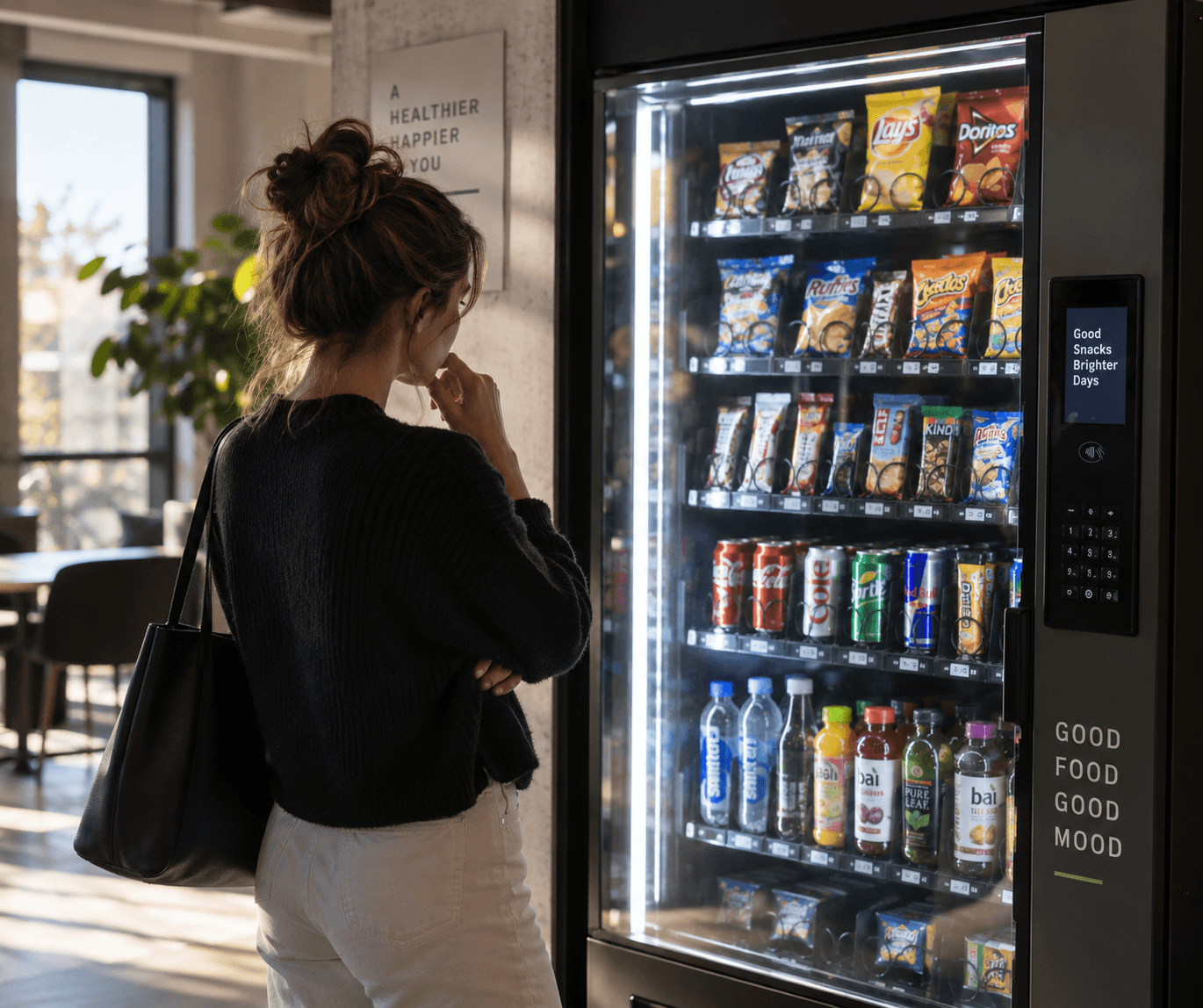
Healthier products were more likely to be selected when they appeared on higher rows and toward the right-hand side of the machine.
Think about what that means operationally. Two identical machines could contain exactly the same 30 products and still potentially produce a different sales mix simply because the planogram is different, with higher sales more likely in high-visibility placements that match the area.
Operators naturally tend to focus on what should go into a machine. The research suggests it may also be worth experimenting with where each product goes. That doesn’t mean moving a granola bar one row higher will suddenly double its sales. Consumer behavior is much messier than that. But it does suggest that every slot in your planogram isn’t necessarily equally valuable, especially as slot value can shift with foot traffic at the machine and local demand.
And that makes product placement something worth testing rather than treating as an afterthought.
2. Consumer behavior: Customers don’t necessarily buy what they say they want
This may be the most entertaining finding. A 2026 study conducted in a Slovenian hospital compared customer survey responses with actual vending sales. When people were asked what they purchased most frequently from vending machines, bottled water came out on top in the survey. The transaction data told a different story. Sweet drinks were actually the most frequently purchased product category.
There are several possible reasons for a discrepancy like this. People may remember some purchases better than others. They may report what they believe they usually choose. Or they may simply answer in a way that reflects what they think they should be buying, especially because many vending machine buys are impulse purchases. Whatever the explanation, there’s a useful lesson here for vending operators:
Watch customer preferences and purchasing decisions, not only what customers tell you they want.
A location manager might insist that employees want healthier snacks. Customers might ask for a particular drink. Someone may tell you that a certain product “always sells.” Those comments can be useful. But your transaction history tells you what people were actually willing to put money into. When the two disagree, sales data deserves your attention.
3. “People want healthier vending” is only half the story
Healthy vending is particularly interesting because researchers have repeatedly experimented with it. In that same 2026 hospital study, researchers changed the product assortment to include more healthy options, testing different product offerings against consumer demand.
The result initially sounds impressive:
Healthy products increased from 22% to 39% of purchases.
But there was a catch.
Total sales declined by 18.81%.
That’s exactly the kind of detail that matters to an operator.
If you only looked at the first number, you might conclude that replacing conventional snacks with healthier alternatives was an obvious success. If you only looked at the second, you’d conclude that healthy vending doesn’t work. The reality is more interesting, because healthier choices, including low-sugar snacks, do not always convert just because they are available.
Customers did shift toward healthier products when those products became more available. But the new assortment also appears to have made some customers less likely to purchase anything at all. That doesn’t mean operators should avoid healthy products. It means product mix matters more than labels like “healthy” and “unhealthy.” The question isn’t simply:
Do my customers want healthy products?
It’s: Which items match product preferences and become the top selling items at this particular location, at this particular price?
4. But healthy vending can work for vending machine sales — sometimes extremely well
Other research shows just how much the result can change depending on the environment and strategy. The City of Philadelphia introduced healthier vending standards across roughly 250 vending machines. The changes involved not only which products were available, but also factors including placement, promotion, pricing, and portion size, showing how vending machines offer healthier choices partly through product curation.
By the final year studied, healthier items represented 40% of snack sales and 46% of beverage sales, even as sugary snacks still remained part of the mix. Healthy snack sales per machine were substantially higher than before the changes. However, total snack sales were 17% lower and revenue declined for both snack and beverage machines. Again, there’s no simple “healthy products sell” or “healthy products don’t sell” conclusion. That’s probably the most useful conclusion of all.
Changing your product mix can shift customer behavior, but whether it improves vending machine sales or creates added value still has to be measured in revenue outcomes.
Operators need to watch both.
5. Price matters — but context matters too
Every operator knows customers notice prices. Research suggests something more nuanced: price sensitivity isn’t necessarily the same across products or environments, and seasonal trends can shape both product movement and seasonal variations in what buyers will pay.
An 18-month study involving 33 vending machines at four bus garages increased healthier options to 50% of the assortment and reduced their prices. Sales of the targeted healthier products increased by 10% to 42%, with employees particularly responsive to pricing changes for snacks, while categories like cold beverages or hot drinks may respond differently depending on timing and setting. But another randomized trial involving 56 university vending machines found that a 25% price reduction for healthier items by itself didn’t produce a significant effect. In that experiment, the combination of healthier snack availability and promotional signage produced better results. That’s an important distinction. It suggests there probably isn’t a universal formula like:
Lower the price by 20% and sales will increase by X%.
The customer, product, competing choices, location, and presentation all interact, and dynamic pricing may work differently by product and location. For an operator, this makes small controlled experiments much more valuable than assumptions.
Change a price. Give it enough time. Look at the sales. Compare. Your own machines can tell you what your customers are price-sensitive about.
6. A hospital customer isn’t necessarily an office customer
The 13,709-transaction study found something else operators should pay attention to: location plays a crucial role in shaping product preferences and customer behavior.
The researchers examined machines in office buildings, universities, educational institutions, and hospitals and found that the context shaped the relationship between healthier and more indulgent choices.
This sounds obvious until you think about how vending operations are often managed. You find products that sell well. Then you put those products everywhere. But the person standing in front of a vending machine at 2 p.m. in an office isn’t necessarily in the same situation as a university student between classes or a hospital worker halfway through a night shift. In transit hubs and other public spaces, higher demand often comes from high traffic alone. Their reason for buying is different. Their available time is different. Their sensitivity to price may be different.Even their definition of a “good” vending option may be different. This is why a product being a poor seller doesn’t necessarily mean it’s a poor vending product.
It may simply be in the wrong machine, and catering the product mix to each setting is what better aligns it with customer needs.
7. Inventory management: Your worst seller might not need to be removed immediately
This is where the research becomes especially useful in day-to-day vending management.
Suppose a protein bar barely sells, even when other Protein Bars in similar machines do fine.The obvious response is to replace it. But before doing that, there are several questions worth asking.Is it too expensive relative to the products around it? Is it sitting in a low-visibility position? Does it sell better at another type of location? Would trail mixes or granola bars perform better? Do some sites respond more to premium products while others over-index on energy drinks? Has it actually been given enough time to establish a pattern?
The research on placement, price, availability, and location suggests that sales performance isn’t purely a property of the product. Sometimes the product is the problem. Sometimes the environment around the product is, especially when health-conscious individuals or younger consumers shape what sells. The interesting part is figuring out which.
Your vending machines are already running consumer experiments
There is a broader lesson hiding in all of this. A vending operator doesn’t need a university research team to start asking better questions. Every machine is already generating evidence through vending machine usage and data analytics that make small tests easier to evaluate.
Move a product. Change a price. Introduce a new item at five locations instead of fifty. Compare an office with a warehouse.
Look at what sells by machine rather than assuming your overall bestseller should be your bestseller everywhere, and review patterns across locations for machine sales and valuable insights. And don’t just look at revenue. Look at units sold, product performance, location performance, stockouts, seasonal demand shifts, and how purchasing patterns change over time. This is where vending management software becomes useful beyond simply keeping track of inventory management for vending machine businesses. With a platform such as VendSoft, operators can review sales across products, machines, locations, and time periods, while smart vending and smart vending machines can support machine functionality, mobile payments, mobile wallets, multiple payment options, and even perishable items tracking, making it easier to identify patterns that would be almost impossible to notice while looking at individual machines.
Want to see what your own vending data can tell you? Start a free 14-day VendSoft trial — no credit card or payment information required.
The goal isn’t to turn every vending operator into a data scientist. It’s much simpler than that.
Pay attention to what your customers are quietly telling you every time they press a selection button—something vending machine operators can learn far faster in-machine than through traditional retail.
Because the fascinating thing about vending machines is that customers don’t have to explain what they want. Eventually, the sales data does it for them.
Sources
Perfetti, A., Pietrini, R., Scarpi, D., & Gistri, G. (2025). Snack dilemma: How vending machines influence choice of virtue and vice foods. Journal of Retailing and Consumer Services, 87, 104369. https://doi.org/10.1016/j.jretconser.2025.104369
Rozman, U., Kac, A., Lavrič, M., & Šostar Turk, S. (2026). Can vending machines promote healthy eating? Evidence from a hospital intervention. Nutrients, 18(2), 293. https://doi.org/10.3390/nu18020293
Pharis, M. L., Colby, L., Wagner, A., & Mallya, G. (2018). Sales of healthy snacks and beverages following the implementation of healthy vending standards in City of Philadelphia vending machines. Public Health Nutrition, 21(2), 339–345. https://doi.org/10.1017/S1368980017001914
French, S. A., Hannan, P. J., Harnack, L. J., Mitchell, N. R., Toomey, T. L., & Gerlach, A. (2010). Pricing and availability intervention in vending machines at four bus garages. Journal of Occupational and Environmental Medicine, 52(Suppl. 1), S29–S33. https://doi.org/10.1097/JOM.0b013e3181c5c476
Hua, S. V., Kimmel, L., Van Emmenes, M., Taherian, R., Remer, G., Millman, A., & Ickovics, J. R. (2017). Health promotion and healthier products increase vending purchases: A randomized factorial trial. Journal of the Academy of Nutrition and Dietetics, 117(7), 1057–1065. https://doi.org/10.1016/j.jand.2016.12.006
Want more vending business tips?
Subscribe to our free 2-week email course and learn how to start a successful vending business.