At 3 a.m., most cafés are closed. Office kitchens are empty. Restaurants have turned off their lights, and in many places, finding something as simple as a cold drink or a quick snack becomes surprisingly difficult.
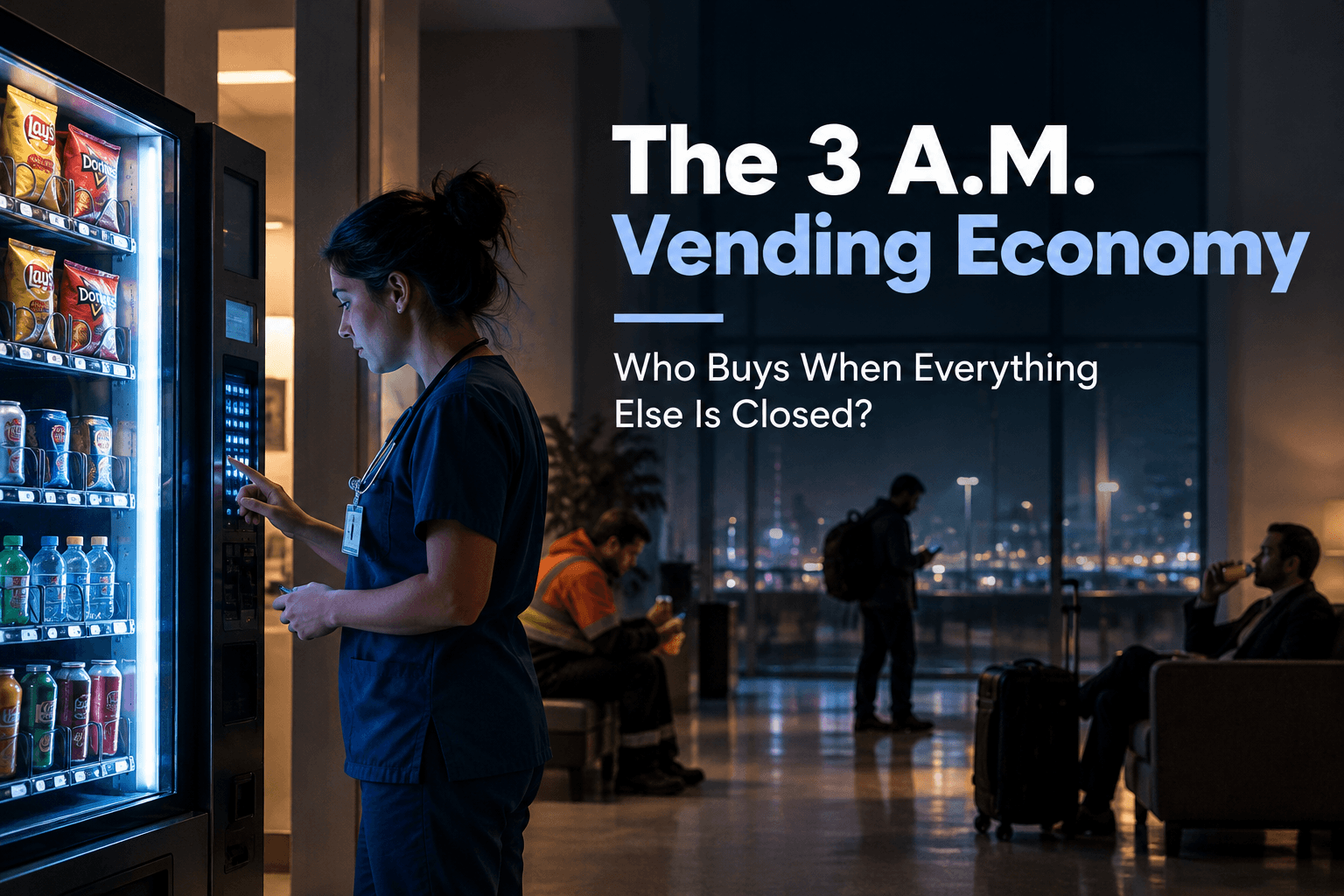
But plenty of people are still awake.
A nurse is halfway through a night shift. A warehouse worker has twenty minutes before going back to the floor. A hotel guest arrives after a delayed flight. A security guard wants a coffee. A student is still studying. A factory is running exactly as it did at 3 p.m.
For these customers, a vending machine isn’t competing with a supermarket aisle full of choices.
Sometimes, it’s the only store open.
There is an entire part of the vending business that exists outside conventional shopping hours. And understanding it can change the way operators think about locations, products, service schedules, and even what makes a vending machine valuable in the first place.
Vending is one of the few truly 24/7 forms of retail
One of vending’s biggest advantages is easy to overlook: a machine doesn’t need someone standing behind the counter.
A convenience store needs staff. A café needs someone to make the coffee. A workplace canteen usually operates during specific hours.
A vending machine can keep selling long after all three have closed.
That matters because modern life doesn’t operate exclusively between 9 and 5.
Hospitals, manufacturing facilities, warehouses, hotels, distribution centers, transportation hubs and many other workplaces operate around the clock. The people inside them still need drinks, food and everyday essentials.
The difference is that their options can become much more limited after normal business hours.
And that’s where vending becomes particularly interesting.
Who is actually buying at 3 a.m.?
The answer depends heavily on the location.
Hospital staff
Hospitals may be one of the clearest examples of the nighttime vending economy.
Doctors, nurses, technicians, security staff and other employees work overnight, while patients and visitors may also find themselves in the building at unusual hours.
A hospital cafeteria might have limited overnight service or close entirely. A vending machine, meanwhile, remains available.
That can make nighttime demand quite different from daytime demand. Coffee, energy drinks, filling snacks and quick meals may matter more than products selected primarily for impulse purchases.
Factory and warehouse workers
Manufacturing plants and distribution centers often operate multiple shifts.
A machine serving the day shift may therefore have a second life when the evening or night shift arrives.
This creates an interesting challenge for the operator: a machine that appears well stocked at the end of the afternoon may be heavily depleted before the next morning.
If the operator only thinks about conventional business hours, they can easily underestimate how much demand actually occurs between service visits.
Hotel guests
Hotels create another unusual vending environment.
Guests arrive late. Someone realizes they want water after getting ready for bed. A traveler needs a snack after a long journey but doesn’t want to leave the building.
In these situations, convenience can matter more than having dozens of alternatives.
Depending on the property, vending can also extend beyond traditional snacks and drinks to travel essentials and other small items guests might suddenly discover they need.
Transportation and travel locations
Airports, stations, rest areas and other travel-related locations don’t follow the rhythm of a normal office.
Travel delays, early departures and late arrivals create customers at almost every hour of the day.
Someone buying a bottle of water at 2:30 a.m. may not be making an impulse purchase at all. They may simply have very few alternatives available.
Universities and student housing
Students are another group whose schedules don’t necessarily align with conventional retail hours.
Late-night studying, shared residential spaces and irregular schedules can create demand well into the night.
And the products people want at midnight may not necessarily be the same products they choose between classes in the afternoon.
The same machine can effectively serve different markets
This is where things become particularly useful from an operator’s perspective.
We often describe a vending machine according to its location:
“the hospital machine”
“the warehouse machine”
“the hotel machine”
But a single location can contain several different customer groups depending on the time of day.
Imagine a machine in a large manufacturing facility.
During the morning, it serves employees arriving for work.
Around lunchtime, snacks and drinks compete with whatever food options are available nearby.
In the afternoon, traffic changes again.
Then the night shift arrives.
The physical machine hasn’t moved, but its competitive environment has changed dramatically. The cafeteria may now be closed. Nearby businesses may be closed. There may be fewer people in the building, but those people have fewer alternatives.
In effect, the machine is operating in several small markets over the course of a single day.
Fewer customers doesn’t always mean an unimportant time period
This is an important distinction.
A location might have much more foot traffic at noon than at midnight. That doesn’t automatically make the midnight customer irrelevant.
During the day, the vending machine might compete with a café, food truck, convenience store or workplace cafeteria.
At night, those competitors may disappear.
This changes the role of convenience.
A person walking past five food options can easily ignore a vending machine.
A person with a 15-minute break at 2 a.m. and nowhere else to buy a drink has a completely different decision to make.
For vending operators, that means location quality isn’t only about the number of people passing a machine.
It’s also about what alternatives those people have when they’re there.
Nighttime demand can change what belongs in the machine
A machine serving significant overnight traffic may also require a different product strategy.
Consider a workplace where employees have access to a cafeteria during the day but rely primarily on vending overnight.
The night-shift customer may be looking for something more substantial than the daytime customer.
That could influence the balance between:
- small snacks and more filling options
- regular drinks and caffeinated beverages
- impulse products and practical meal replacements
- traditional snacks and healthier alternatives
- single products and combinations that can make up a quick meal
The right assortment still depends on the individual location. The important point is that operators shouldn’t assume demand is identical throughout the day.
Sales history can reveal things that intuition misses.
It can also change when you should service the machine
Imagine servicing a busy 24-hour location at 4 p.m.
Everything looks good when you leave.
Then an evening shift and a night shift use the machine before the morning staff arrive.
By 8 a.m., several popular selections are empty.
Technically, the operator serviced the machine recently. From the customer’s perspective, however, it wasn’t serviced at the right time.
This is one reason route planning isn’t simply about visiting each machine every X number of days.
The timing of demand matters too.
For a machine with substantial overnight sales, servicing before or after a major shift change could make a meaningful difference to product availability.
The same applies to weekends. A location’s busiest vending period doesn’t necessarily correspond with its operator’s normal working hours.
What does your sales data look like while you’re asleep?
If your machines use telemetry or another system that records individual transactions, it’s worth looking beyond daily sales totals.
A machine might generate $300 in a day, but when were those sales actually made?
Breaking sales down by time can reveal patterns that aren’t obvious from the total alone.
You might discover that a meaningful share of sales happens after 8 p.m. Or that one machine becomes surprisingly active around a particular shift change. Another may sell almost nothing overnight despite being accessible 24 hours a day.
Those differences can help answer practical questions.
Does the machine need more capacity for certain products? Are particular items consistently selling out before morning? Would a different service time make more sense? Does the location behave differently on weekdays and weekends?
The goal isn’t to obsess over every individual transaction.
It’s to understand the rhythm of the location.
A good vending location isn’t just about foot traffic
When evaluating a potential location, operators naturally want to know how many people are there.
That’s important, but it isn’t the whole story.
It can also be useful to ask:
When are those people there?
How long are they there?
Can they easily leave?
What food and drink options are available to them?
And perhaps most importantly: what happens when those alternatives close?
A workplace with 150 people on an overnight shift and very limited food options might present a very different vending opportunity from an office with far more employees who can walk to several restaurants and stores.
The raw population number doesn’t tell you everything.
Convenience is partly about proximity. But it’s also about availability.
The quiet advantage of vending
There’s something unusual about a vending machine at 3 a.m.
Nobody has to decide whether it’s worth keeping the store open.
Nobody has to cover the night shift.
The lights don’t need to be turned on because a customer walked through the door.
The machine simply sits there, ready for the next transaction.
For operators, that creates opportunities in places where traditional retail becomes difficult or uneconomical.
For customers, it can turn an ordinary vending machine into something much more useful.
During the afternoon, it might be one option among many.
At 3 a.m., it might be the only one.
Know what’s happening across your route — even when you’re not there
Managing machines that sell around the clock becomes much easier when you have a clear picture of what’s happening across your route.
VendSoft helps vending operators manage machines, inventory, planograms, restocking trips, warehouse stock, sales data and reporting from one system, so you can make decisions based on what your machines are actually doing.
You can try VendSoft free for 14 days. No credit card or payment information is required.
Start your free trial and see how VendSoft can help you run your vending business more efficiently.
Want more vending business tips?
Subscribe to our free 2-week email course and learn how to start a successful vending business.