Vending machines in schools can be a steady, low-maintenance revenue stream — but unlike offices or gyms, schools are gated by policy before they’re ever gated by traffic. A district or school has to allow vending at all, and once it does, everything you stock has to fit strict nutrition rules. Get both of those right and a school route can run for years with minimal turnover.
That’s the short version. Here’s what it actually takes to evaluate a school as a location, making placement decisions based on policy, available space, and student needs, handle the objections you’ll hear, and build a product mix that passes muster on day one.
Why Schools Work as a Location — and Where They Don’t
Schools aren’t a single location type — they’re several, and the differences matter more here than in almost any other category you’ll evaluate.
Enrollment and grade level set the ceiling. A high school with 1,200+ students and an open campus or long passing periods is a fundamentally different opportunity than an elementary school with 400 kids and a closed campus. Middle and high schools tend to have more autonomy over vending policy, longer stretches between meals, and older students who are allowed to purchase independently. Elementary schools are far more restricted — many don’t allow student-facing vending at all, and where it exists, it’s often staff-only. If you’re prospecting, middle and high schools with four-digit enrollment are where the numbers start to work, and what most schools choose when the numbers work.
Traffic is concentrated, not constant. Office vending gets grazed all day. Gym vending clusters around class times and open-gym hours. School vending is different again: sales bunch up hard around lunch periods and the few minutes of passing time between classes, with operating hours narrow and concentrated around those windows and long dead stretches during instructional blocks. A machine that looks slow on an hourly average can still be a strong performer if you’re only measuring the 20-30 minutes a day when the hallway is actually full.
Policy is the real gatekeeper. This is the one location type in this series where you can find a building with great headcount and a genuine snack gap, and still not be able to place a machine — because the district’s wellness policy doesn’t permit it, or because approval has to come from a school board or superintendent’s office rather than the person standing in front of you. Before you spend time on product mix, confirm that vending is currently allowed, or that there’s a real path to getting it approved before you choose equipment or set price. Everything else is downstream of that one question. The best machine is usually located near lunch areas or main student traffic without blocking space.
Should Schools Have Vending Machines?
If you’re pitching a school vending machine, you’ll run into this debate eventually, so it’s worth knowing both sides. Critics argue that vending machines undercut nutrition education and give students easy access to low-value snacks and drinks during the school day. Supporters — often the same administrators you’re trying to sign — point to vending as a low-effort revenue source that funds student programs, sports, and clubs without raising fees or relying on additional fundraisers.
Neither side is going away, and you don’t need to litigate it. What you need is an answer that reframes the conversation: modern school vending isn’t the same product mix that fueled that debate a decade ago. Federal nutrition standards now determine what can legally be sold, which takes most of the “junk food” argument off the table before you even start pitching.
Compliance with School Policies Is the Core Differentiator for School Vending
Any food or beverage sold in a vending machine on a public school campus during the school day is subject to the USDA’s Smart Snacks in School standards. These rules apply to items sold anywhere on campus — vending, school stores, à la carte lines — not just cafeteria meals, and they’re enforced at the district level as a condition of federal funding. For an operator, that means your entire product list has to meet specific nutritional thresholds before a single item goes on the planogram.
At a high level, Smart Snacks sets limits across several categories:
- Calories — snack items generally need to stay under a per-serving calorie cap, and entrée-type items have their own, higher threshold.
- Fat — total fat, saturated fat, and trans fat all have limits; trans fat is effectively excluded entirely.
- Sugar — total sugar per serving is capped, which rules out most traditional candy, pastries, and high-sugar snack bars.
- Sodium — sodium limits are tighter than most people expect, and they knock out a lot of standard chip and cracker SKUs that would be fine in an office machine.
- Beverages — plain water and bottled water, low-fat and non-fat milk, and 100% juice in controlled portions are generally allowed; sports drinks, energy drinks, and full-sugar soda are not permitted during the school day in most cases.
Districts expect operators to ensure every machine is stocked with items that comply with Smart Snacks rules on day one.
The practical effect is that a product list built for an office break room won’t survive a Smart Snacks review. Regular potato chips, full-size chocolate bars, and standard soda are out. What’s left is a narrower — but still commercially viable — category of compliant snacks and beverages, and the operators who do well here are the ones who treat that narrower list as a feature, not a limitation: it’s the reason a district will approve you in the first place. Modern systems can also provide automatically generated compliance reporting to support district review.
One thing operators consistently underestimate: even within a compliant product set, sell-through varies a lot by SKU. VendSoft shows exactly which compliant items are moving and which are sitting — so you’re not guessing which “healthy” options students actually buy versus which ones just take up a slot.
Product Mix and Machine Type for School Vending
Once you know a building is compliant-friendly, the product mix follows a pretty clear pattern, and it’s worth contrasting it directly against the office and gym mixes covered elsewhere in this guide.
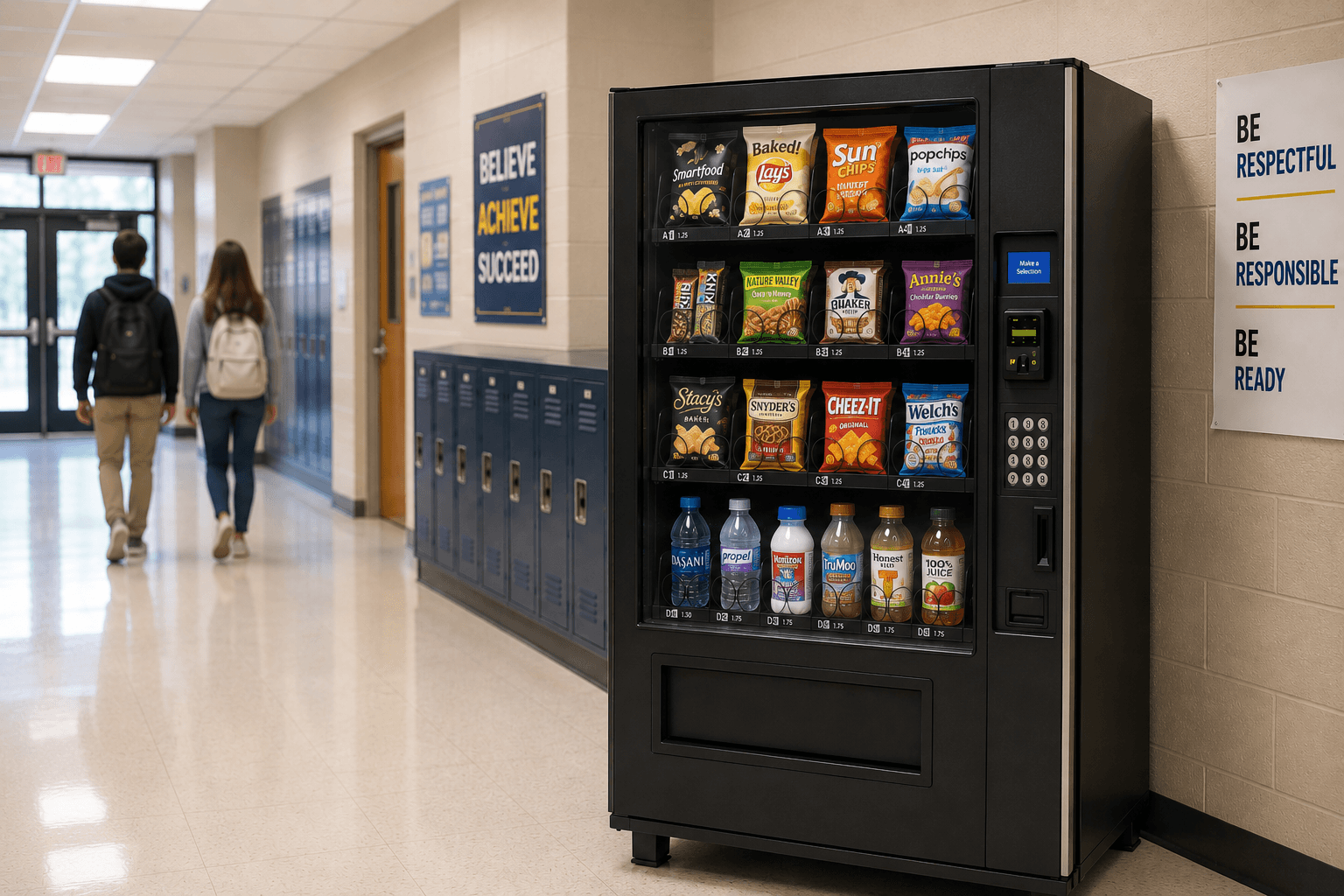
Snacks: Baked chips instead of fried, whole-grain crackers, granola and cereal bars with reduced sugar, pretzels, and lower-sodium popcorn tend to anchor a compliant school lineup, with enough variety inside that narrower set to cover different student preferences. This is a meaningfully smaller category than what works in an office machine, where indulgent, high-margin snacks are often the top sellers — in a school machine, those same SKUs are usually disqualified outright.
Beverages: Water and low-fat or non-fat milk are the safe, compliant core, often supplemented with 100% juice in small portions, and some schools also find bottled water the most dependable seller. This is the sharpest contrast with gym vending, where electrolyte and sports drinks are frequently the best-performing category — in a school machine, those products are largely off the table during the school day.
Machine selection: Because compliance is time-gated — Smart Snacks rules generally apply during the school day but not necessarily after hours or during evening events — smart vending machines are often the best fit when schedule controls and reporting matter. That lets you run a fully compliant mix during school hours and open up additional SKUs for evening sports, PTA events, or community use, without swapping physical inventory, while also preserving the ability to accept cash, mobile payments, mobile wallets, and Apple Pay where the school allows broader payment access. If schedule-based control isn’t available on the machine you’re placing, the fallback is simply keeping the entire machine Smart Snacks-compliant year-round, which is the safer default for most first-time school placements anyway.
How to Pitch School Vending Machines
The sales process for schools looks nothing like pitching a gym owner or an office manager, and treating it the same way is the most common mistake new operators make. In practice, running school vending means dealing with more stakeholders and more formal approval steps.
Know who actually decides. You’re rarely pitching one person. At the building level, it’s typically a principal or business manager. At the district level, food services or procurement often has to sign off, particularly because Smart Snacks compliance is something districts are accountable for. In some districts, a PTA or school board vote is part of the approval chain, especially if vending revenue is earmarked for a specific student program, and the school should receive clear documentation on compliance, pricing, and responsibilities.
Lead with compliance, not convenience. With an office manager, “your team will love having snacks on-site” is a strong opener. With a school decision-maker, that framing falls flat — their first concern is whether you understand and will maintain Smart Snacks compliance without them having to police it. Make clear who is responsible for restocking, repairs, and ongoing service so support does not fall on school staff. Open with that, and convenience becomes a secondary benefit rather than the pitch itself.
Lead with revenue share for their programs. Because school vending profit is often earmarked for a specific purpose — a music program, athletics, a student council fund — a revenue-share structure tends to land better than a flat placement fee. It reframes the machine from “outside vendor equipment” to “a funding source the school controls a piece of,” which is usually the deciding factor in close calls, especially when the vendor can operate the machine, set the price within approved guidelines, and handle delivery without adding work for the school.
Where Schools Fit in the Bigger Picture
Schools are one of three location types covered in our Profitable Vending Machine Locations: 2026 Guide, alongside our breakdowns of office vending and gym vending. If you’re comparing location types side by side, the short version is this: offices offer the most flexible product mix and the most consistent all-day traffic, gyms reward a narrow but high-margin performance-nutrition mix, and schools trade product flexibility for policy-backed stability — once you’re approved and compliant, turnover tends to be low and the relationship tends to last.
Some operators also expand beyond snacks and drinks into school supplies when student demand supports it, with supplies treated as an optional extension rather than a core compliant offering.
Want to see how your compliant product mix is actually performing? Start a free 14-day VendSoft trial — no payment info required.
Want more vending business tips?
Subscribe to our free 2-week email course and learn how to start a successful vending business.