One of the first questions people ask when considering vending as a business is a simple one: how many vending machines would I actually need to make a living?
There is no fixed number. For most operators, the answer depends on how much profit each machine produces and what income you need, which is why one person might need 10 strongmachines while another needs 30 or 40 to reach the same goal.
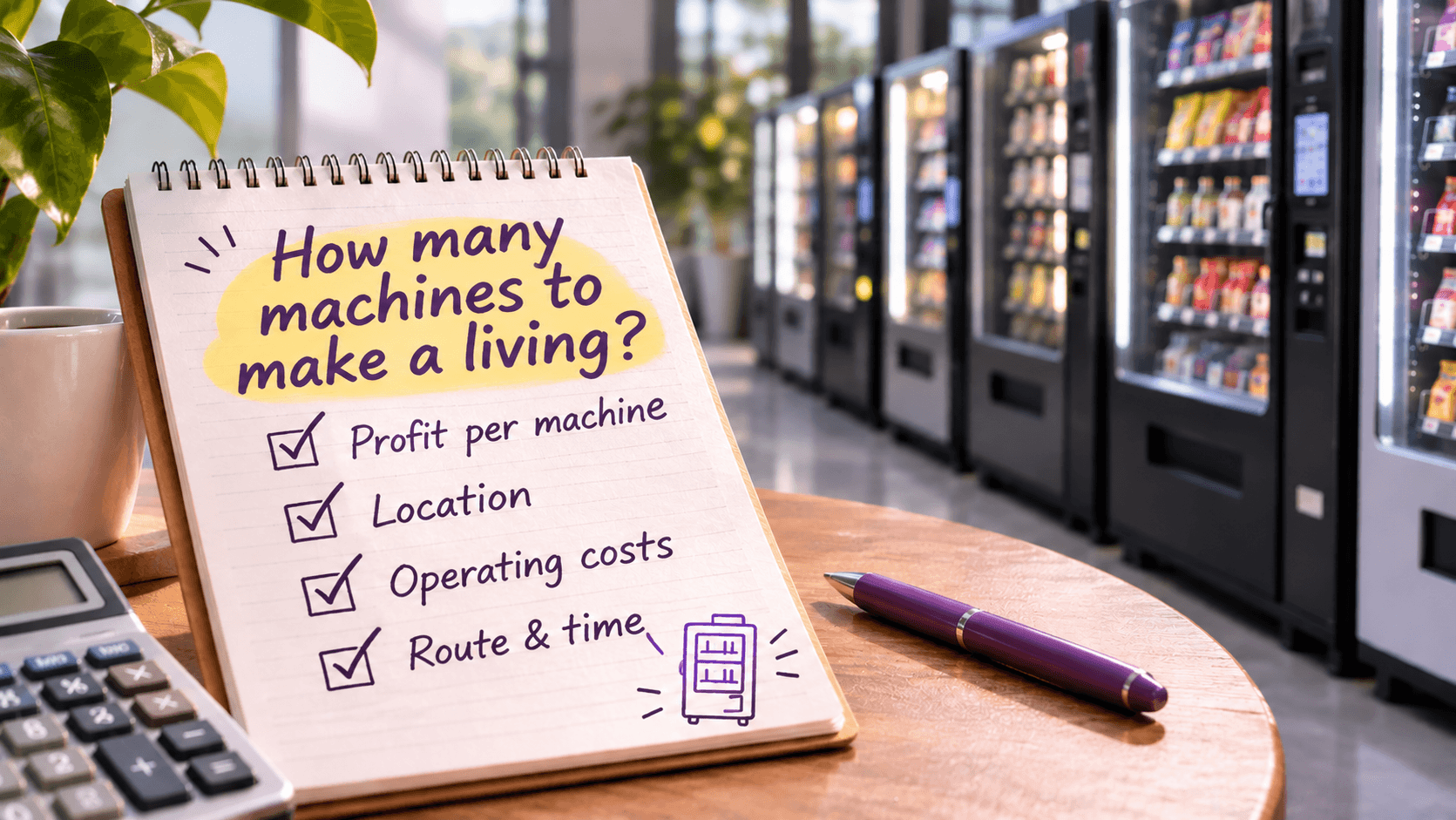
It would be convenient if there were a number. Ten machines. Twenty. Fifty. Reach it, quit your job.
In reality, the number of machines tells you surprisingly little on its own. One well-placed vending machine can outperform several machines in weak locations, and two operators with exactly the same number of machines can end the year with very different incomes.
So instead of starting with a target number of machines, it makes more sense to work backwards from the income you want and understand what each machine is actually contributing. If you’re thinking about starting a vending machine business or growing the one you already have, that shift helps you set realistic targets, avoid common mistakes, and focus on profit and route efficiency rather than machine count alone.
That’s what this article will help you do: estimate how many machines your income goal may require by looking at per-machine profitability, location quality, route density, operating costs, and the basic math behind a vending business that can actually support you.
Start your vending machine business with profit, not sales
Imagine a vending machine generates $1,000 in sales in an average month. That doesn’t mean the operator has made $1,000.
The products have to be purchased. There may be a commission paid to the location. Card transactions come with processing costs. Fuel, vehicle expenses, repairs, insurance, software and other operating costs all take their share. Product costs, taxes, card-processing fees, and servicing also eat into profits, reducing what you actually net and can pay yourself. There is also the value of the operator’s time spent buying inventory, loading the vehicle, driving the route, restocking machines and handling problems.
What matters is what remains after those costs.
For a simple example, suppose a machine generates $800 per month in sales and, after product costs and the other expenses associated with operating it, contributes $250 in profit—the number to focus on is profit per machine, not the cash collected from sales.
If your target is $5,000 per month, the calculation looks straightforward:
$5,000 ÷ $250 = 20 machines
Twenty machines producing that result consistently could theoretically generate the target income.
But change the performance of those machines and the answer changes very quickly.
If each machine contributes only $125 per month, you would need 40 machines to reach the same $5,000. If each contributes $500, you would need only 10.
That’s why asking how many vending machines you need is really asking another question: how much profit can you generate from each location?
Ten good machines can be better than thirty mediocre ones
It’s easy to think that growing a vending business means making a deliberate plan to expand, not adding as many machines as possible as fast as you can. But every additional machine also becomes another location to monitor, stock and service.
Consider two hypothetical routes.
Operator A has 30 machines producing an average of $150 in monthly profit each. That’s $4,500 per month.
Operator B has 15 machines producing an average of $300 each. That’s also $4,500.
The income is identical, but the businesses aren’t, and machine count alone doesn’t tell you much about the whole business.
Operator B has half as many machines to monitor, fewer stops to make and potentially much less driving, loading and servicing. Of course, real routes have other variables, but the example illustrates why machine count alone isn’t a particularly useful measure of the size or quality of a vending business.
A machine that barely earns enough to justify the trip can actually make a route worse, especially if it sits far away from the rest of the locations.
The goal isn’t simply to have more machines. It’s to have machines that justify the work required to operate them.
Location changes everything
A machine in offices with 25 employees and a machine in a busy manufacturing facility with hundreds of workers might occupy roughly the same amount of floor space. Their earning potential can be completely different.
Foot traffic matters, but so does the type of traffic.
How long are people at the location? Do they have easy access to other food and drinks? Are they there every day? What shifts do they work? Are nearby stores open when they’re on break? Who is the owner or manager of the site? Are there nearby small businesses or stores competing for the same purchases? How many other vending machines or food options are competing for the same purchases?
A location with fewer people can sometimes outperform a busier one simply because those people have a stronger reason to use the machine.
The commission arrangement matters too. A high-volume location may look impressive in a sales report, but if it requires a substantial percentage of revenue to be paid back to the location, the difference in actual profit may be smaller than expected.
The site itself is usually one of the biggest factors in what a machine can earn.
This is why evaluating locations based on sales alone can be misleading.
Your route matters almost as much as your machines
There is another cost that’s easy to overlook when estimating how many vending machines you need: distance.
Twenty machines clustered within a compact area are very different from twenty machines scattered across a large region.
Every unnecessary mile costs fuel and time. Every unnecessary visit does the same.
If an operator spends an entire day servicing machines that could have been handled in half a day with a better route, that inefficiency becomes part of the cost of running the business. As the number of machines grows, small inefficiencies start multiplying.
This is also why servicing every machine on the same fixed schedule isn’t always ideal. A busy machine might genuinely need attention several times a week, so you may need to check it more often, while a slower one may be nowhere near empty after seven days.
Knowing which machines actually need a visit — and what to fill before you get there — can make a larger route considerably easier to manage.
So, how many vending machines could replace a salary?
The best way to estimate this for your own business is to start with the monthly income you want to generate and divide it by the average monthly profit per machine, not average sales.
For example:
Target monthly income | Average profit per machine | Machines needed |
|---|---|---|
$3,000 | $150 | 20 |
$3,000 | $300 | 10 |
$5,000 | $200 | 25 |
$5,000 | $300 | 17 |
$5,000 | $500 | 10 |
$7,500 | $300 | 25 |
These aren’t promises of what a vending machine will earn. They’re examples showing how dramatically the required machine count changes depending on the economics of each location, and a machine typically needs some time before earnings settle into a reliable pattern.
And even this calculation needs some caution. From the point you decide to start, it can take time to secure a location, install your first machine, and collect the first cash. Business profit and personal take-home income aren’t necessarily the same thing, and early numbers often matter less than whether the basic cycle works because there can be some noise at the start. Taxes, reinvestment, unexpected repairs, new equipment purchases and fluctuations in sales all need to be considered before deciding that a vending business can reliably replace a salary, which is why a realistic plan should include a margin of safety.
Someone aiming to live entirely from vending would therefore be wise to build a margin of safety rather than reaching a theoretical income target and immediately assuming every dollar is available to spend.
Before adding another machine, look at your first machine and the ones you already have
For an operator trying to grow, the natural instinct is often to ask, Where can I place my next machine? But before you buy another machine, it usually makes more sense to secure the location first. A signed location can also make the machine financeable.
Sometimes the better question is whether the existing route could produce more.
A machine with poor product selection may have room to improve. A location being visited too frequently may be consuming unnecessary time. Products that repeatedly expire or return to the warehouse are tying up money. A focused mix of snacks, candy, and soda at the right price per unit can improve results. A machine with impressive revenue but high costs, including a card reader and other operating expenses, may be less valuable than it appears.
Conversely, a consistently strong location may tell you exactly what kind of account is worth pursuing next. Start with real place prospects nearby, not just broad categories, and if you use a mapping tool to spot local opportunities, you may need an account to access it. Plan on about 20 walk-ins for one vending location, ask for the right person, and record the contact for follow-up. Your pitch should lead with the benefit to the business, not just the machine itself. The goal is to learn before you expand.
Once you understand those patterns, expansion becomes more deliberate. Instead of accumulating machines, you’re building a route around locations that have demonstrated that they work.
There is no magic number, and you can still lose money
You don’t need 20 vending machines to make a living. You also can’t assume that 20 vending machines will allow you to make one.
The number depends on what those machines sell, what it costs to operate them, how profitable their locations are, where products are bought, including wholesale sources like Costco for candy and soda, what the owner has to pay for them, and how efficiently you can service the route.
For someone building a vending business, that’s actually useful news. It means growth isn’t limited to constantly buying more equipment. Chasing a bargain machine before you have a location can leave it sitting in a garage or another place to store it, which can push you toward accepting a weak site; a secondhand machine may still cost about $1,500, and some operators start with startup costs under $2,000 total. The first product fill often adds another $200 to $400. Even a low price can mislead if the machine comes with hidden problems, and freight can add roughly $150 to $500 if the machine is not local. Improving the performance of existing machines, removing poor locations and running a more efficient route can change the economics without increasing the machine count at all. Even a low price can mislead if the machine comes with hidden problems or the site is weak, and a cashless card reader can raise sales by about 20% to 30%, so skipping one can cost a lot over time.
So rather than asking How many vending machines do I need?, start with three numbers:
How much do I want the business to produce to pay for everyday living, not just for fun? How much does each machine actually contribute after products are sold and all the other things are paid for? And how much work does it take to earn it?
Those answers will give you a much more useful target than machine count ever will.
Know what your vending machines are actually earning. VendSoft helps vending operators track sales, inventory, expenses and profitability while planning more efficient routes from one place. Start your 14-day free trial — no credit card required.
Want more vending business tips?
Subscribe to our free 2-week email course and learn how to start a successful vending business.