Landing a busy vending location is usually something to celebrate. But vending machine location profitability is not just about strong sales—it depends on whether the machine can meet demand without constant sellouts or excessive service calls, and whether the setup still fits what the location is capable of producing.
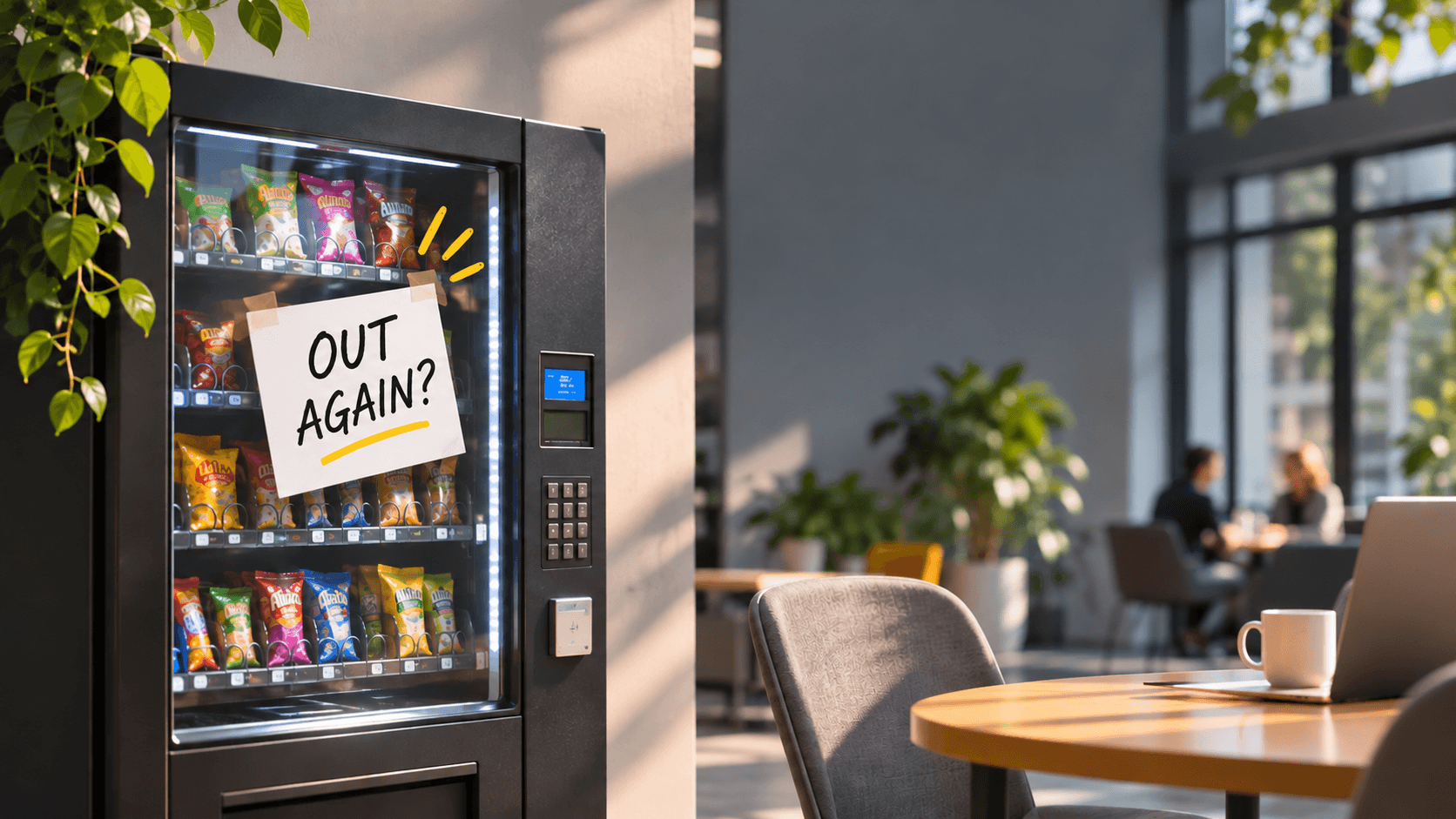
For vending operators and other professionals managing vending locations, that difference matters. A machine that constantly sells out may look great in a sales report, but if you have to visit it three times a week just to keep popular products available, those numbers tell only part of the story. The location may be capable of generating more revenue than the current setup allows, while also draining time and service capacity.
That raises the real question: when should you stop trying to get more out of the existing vending machine and start thinking about a different setup? The answer usually comes from comparing sales against service frequency, looking at whether product variety and capacity are limiting demand, and deciding if the location needs a second machine, a different format such as a smart cooler, or a larger upgrade like a micro market. This article focuses on how to spot those signals early and use location data to make the most profitable next move.
Selling out isn’t always good news for a profitable vending machine
An occasional empty selection is normal. Demand changes, certain products unexpectedly become popular, and even well-planned routes will sometimes arrive after the last Coke or Snickers has been sold.
Consistent sellouts are different.
Imagine a machine in a busy workplace that is serviced every Monday and Thursday. By Wednesday afternoon, several of its best-selling drinks are regularly gone. The same thing happens again before the next visit.
The obvious response is to stock more, but there may simply be nowhere to put it. Adding more units of one product means reducing space for another. Increasing service frequency can solve the availability problem, but now the operator is adding another stop to the route.
At some point, the question changes from How can I stock this machine better? to Is this still the right machine for this location?
This is particularly important because a sold-out product creates a type of lost revenue that can be difficult to see. The sales report shows everything that was purchased. It cannot show every purchase somebody would have made if the product they wanted had still been available.
A machine can therefore appear to be performing exceptionally well while simultaneously leaving money on the table.
Look at what high traffic locations are asking for
Capacity isn’t the only reason a location can outgrow traditional vending.
Sometimes the clearest signal comes from what people want to buy.
A machine may have been installed when a location had 50 employees and mostly needed drinks and snacks. A few years later, there may be 150 people using the space, working longer shifts and asking for sandwiches, salads, ready meals or a wider variety of drinks.
The operator can keep rearranging the planogram, but there is a physical limit to how much variety can fit inside a traditional machine.
This is one reason operators now have more choices than simply installing another setup, because traditional machines can still fit some sites while higher-capacity or higher-margin vending machines make more sense in others. Smart coolers can accommodate a broader mix of products in a relatively compact space, while micro markets can offer substantially more choice when the location has enough traffic and physical space to support them. For example, different machine types can justify different formats: traditional snack machines often generate $300 to $900 monthly, coffee vending machines can run at margins of 60-70%, and smart vending machines can generate over $22,000 in a month. Industry operators are increasingly treating these formats as different tools for different locations rather than assuming one should replace all the others.
The important part is not choosing the newest technology. It is recognizing when customer demand no longer fits the format currently being used.
Service frequency and cashless payment systems can tell you as much as sales
A high-revenue location isn’t necessarily a highly profitable one.
Suppose two machines each generate $2,000 per month in gross sales. The first needs one predictable service visit each week. The second needs three visits because popular selections constantly sell out, so the gross revenue matches while net profit does not.
The revenue figure is the same. The operational cost isn’t. Food and beverage product costs often run at a 40% to 50% cost of goods ratio, and product restocking costs can consume another 30% to 50%, which compresses vending machine profit.
Those extra visits mean driving time, fuel, labor, picking products, loading the vehicle and potentially disrupting the rest of the route. If one successful machine repeatedly forces an operator to change the week’s schedule, its performance should be evaluated differently by subtracting operating costs from sales to estimate net profit, especially since net profit margins often land around 20-35% of gross revenue.
That doesn’t automatically mean the machine needs to go. Adding another machine may be the simplest solution. Changing the product mix or giving additional space to fast sellers may solve the problem. A location with strong refrigerated demand might be better suited to a smart cooler, while a sufficiently large and predictable customer base could potentially support a micro market.
What matters is looking beyond total gross revenue and asking how much work is required to produce it and what remains as net profit.
Don’t upgrade a location in your vending machine business just because you can
There is another side to this.
Newer doesn’t automatically mean better.
A machine producing strong, steady sales and requiring one efficient visit a week may be doing exactly what it is supposed to do. Replacing it with a more expensive setup simply because the location is successful can turn a good account into an unnecessary investment.
Even frequent sellouts need some context. If one drink suddenly becomes popular, changing its position or giving it another column may be enough. If demand spikes only during summer, expanding the entire location based on three unusually strong months may not make sense either.
Before changing the format, operators need enough history to know whether they are seeing a temporary peak or a pattern. That also means validating foot traffic rather than assuming it, ideally with observed counts or comparable evidence, because location quality can look stronger on paper than it is in practice.
This is where the data becomes useful. Look at how sales have changed over time. Which products repeatedly sell out? How often is the location being serviced? How quickly does inventory move after each visit? Is demand concentrated in a few products, or are customers buying broadly across the machine? Is revenue still growing, or has it reached a ceiling despite strong traffic? As a baseline, foot traffic volume of about 50 to 100 people a day is often more useful than raw estimates, and static traffic usually converts more reliably than transient traffic.
Taken together, those patterns tell you far more than a single month’s revenue.
The right answer might simply be another machine
It is tempting to frame the decision as traditional vending versus smart coolers or micro markets, but in practice the answer can be much less dramatic.
If a beverage machine is constantly empty while the snack machine next to it is performing normally, adding beverage capacity may solve the entire problem. If customers are asking for fresh meals and larger refrigerated products, another traditional machine may not solve it at all.
The decision should start with the problem, not the equipment. The economics also depend on the agreement with the site, so negotiating clear revenue sharing matters before expanding.
Smart coolers can offer refrigerated and fresh products in locations where a full micro market would require too much space or investment. Micro markets can make more sense where sustained traffic supports a larger assortment and customers have room to browse and buy several items at once. Traditional vending remains an efficient option where a predictable assortment, compact footprint and straightforward service model are exactly what the location needs.
There doesn’t have to be a universal threshold at which one becomes better than another. A location with 100 people can behave very differently from another location with 100 people. Shift patterns, working hours, nearby food options, available space and what those particular customers actually buy all influence what the location can support. Commissions paid to property owners commonly run about 5% to 15% of gross sales, and that should be defined in a signed placement agreement to protect your investment.
Let the location prove what it needs
The best time to reconsider a vending setup isn’t necessarily when the machine is doing badly. Sometimes it is when the machine is doing so well that its limitations become visible.
Repeated sellouts, rising service frequency, growing demand for products that don’t fit comfortably in the machine and sustained increases in sales can all be signs that it is worth looking at the location again. They can also show whether limited cashless payment capability is suppressing vending machine revenue.
That doesn’t mean every successful vending machine should become a smart cooler or every busy account should become a micro market. Often, a better planogram, more capacity or an additional machine is enough.
The goal isn’t to upgrade the equipment. The goal is to make sure the equipment hasn’t become the thing holding a good location back.
For operators managing dozens or hundreds of machines, that is difficult to judge from instinct alone. Tracking sales, inventory and service history in a vending management system such as VendSoft makes it easier to spot locations where demand is consistently pushing against the limits of the current setup—and to distinguish them from machines that simply had a particularly good week. Modern cashless payment systems matter here because cashless payment drives most U.S. sales now—about 75% of vending revenue in 2024—can lift sales by 30% or more, and often leads customers to spend more per transaction.
A successful location has already done the hardest part: it has proven that people want to buy. The next question is whether you’re giving them enough opportunity to do it.
Want a clearer picture of how your vending locations are performing? Try VendSoft free for 14 days and see how it can help you track sales, inventory, service visits and machine performance in one place. No credit card or payment information required.
Want more vending business tips?
Subscribe to our free 2-week email course and learn how to start a successful vending business.