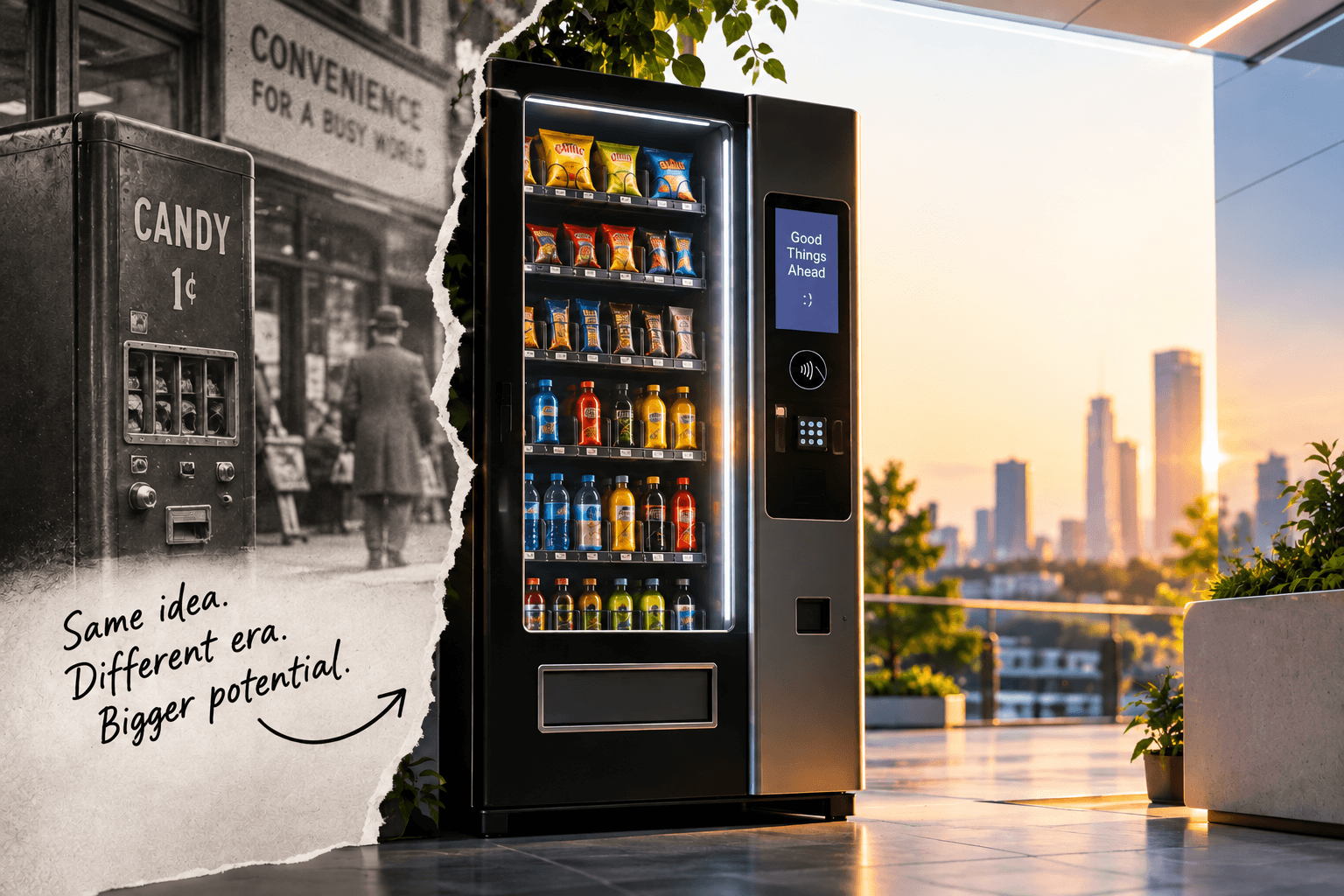
Walk past a vending machine and you’re looking at one of the oldest and most durable forms of autonomous retail. Not a snack dispenser, but a fully unattended point of sale that takes payment, manages its own inventory signals, prevents most theft by design, and operates without a single staffed hour — and has done so for decades before “autonomous retail” was a category anyone pitched to investors.
That framing sounds like a stretch until you look at what’s happened to the more celebrated autonomous-store experiments over the past two years. Amazon has spent that time quietly closing Just Walk Out–powered Go stores, unable to make the lease economics work even where the format was performing well. Walmart, Target, Dollar General, and Five Below have all pulled back self-checkout lanes after theft and “shrink” outpaced the labor savings they were meant to deliver. Meanwhile, the humble vending machine — never staffed, never dependent on a customer to scan honestly, never requiring an “attendant” to remove in the first place — has just kept running.
That’s not a coincidence, and it’s not because vending is simpler than a grocery store. It’s because vending solved the hardest part of autonomous retail — the absence of an employee — by design, decades before anyone tried to engineer it out of an existing staffed format. Everyone else is retrofitting. Vending never had to.
For retail operators weighing automation, investors tracking autonomous formats, and industry professionals studying where the model actually works, the useful question isn’t whether vending “counts” as autonomous retail. It’s what vending can teach the rest of retail about labor economics, continuous operation, shrink control, why self-checkout and camera-based stores struggle at scale, and how micro markets extend the same unattended logic into a broader format.
The progression nobody mapped
Retail’s shift toward autonomy usually gets told as a straight line: cashiers, then self-checkout, then fully autonomous stores like Amazon Go, with vending machines mentioned somewhere in a footnote about “other unattended formats.” That ordering is backwards. It assumes autonomy is something you subtract from a staffed store, one function at a time, until nobody’s left.
A more accurate progression looks like this:
- Traditional retail — a store built entirely around staffed labor, from checkout to restocking to loss prevention.
- Self-checkout — labor partially removed from the transaction, while the store itself, its inventory systems, and its loss-prevention model stay staffed and centralized.
- Smart vending — newer connected formats expanded beyond traditional vending, which relied on mechanical systems and a limited product selection, into retail locations with no staffed labor at any point in the transaction, running on remote telemetry instead of a store manager.
- Micro markets — vending’s logic applied to a browsable, multi-SKU footprint, still unattended, still running on the same remote-monitoring backbone.
- Autonomous retail — the broader category all of the above is now understood to belong to, including camera- and sensor-driven “walk out” formats.
Self-checkout sits in an awkward middle position: it removes the cashier but keeps almost everything else about a staffed store, including its exposure to theft. Smart vending and micro markets skip that middle step entirely. There was never a cashier to remove, so there was never a labor cost to defend or a “will customers accept this” adoption curve to climb. The format was unattended from its first installation.
That’s the argument worth sitting with: vending isn’t a primitive precursor to autonomous retail. It’s the version of autonomous retail that already cleared the hardest hurdle — full removal of on-site labor — while the rest of the industry is still negotiating it store by store.
Self-checkout’s reckoning
The clearest evidence that “remove the labor” is harder than it looks is what’s happening at the format built to do exactly that. Self-checkout was supposed to be retail’s transitional step toward autonomy. Instead, it’s becoming a cautionary tale about doing autonomy halfway.
Walmart has removed self-checkout lanes at stores in Missouri, Pennsylvania, and elsewhere after police data showed theft-related calls dropped sharply once the machines came out. Dollar General eliminated self-checkout at roughly 12,000 locations. Target now caps self-checkout to shoppers with ten items or fewer. Five Below has pulled kiosks from its highest-shrink stores. The National Retail Federation has reported a sharp rise in shoplifting incidents since 2019, and research from checkout-technology firm Grabango found theft occurring in a meaningfully higher share of self-checkout transactions than staffed ones.
None of that is an argument against automation. It’s an argument against automating the transaction while leaving the accountability structure of a staffed store in place. Self-checkout asks a customer to do a cashier’s job without a cashier’s incentives, oversight, or physical presence to deter dishonesty — and expects the surrounding store, built for a staffed model, to absorb the difference. It’s autonomy applied to one step of a process that wasn’t redesigned around it.
Vending machines never had that problem, because they were never asked to trust the customer’s scanning honesty in the first place. Payment happens before product release, not after self-reported selection. That single sequencing difference — pay first, receive after — is a large part of why vending’s loss-prevention story looks nothing like self-checkout’s.
The Amazon problem: When “autonomous” costs more than it saves
If self-checkout shows what happens when you automate a transaction without redesigning the store around it, Amazon Go shows what happens when you build the fully autonomous store first and worry about the economics later.
Just Walk Out technology — computer vision, sensor fusion, and weight-sensitive shelving that lets a shopper leave without a formal checkout — is genuinely sophisticated. But computer vision can misread products in poor lighting or when packaging looks similar, which adds to operational complexity. Amazon reports the system has processed tens of millions of items across hundreds of third-party locations. But Amazon has also closed a large share of its own Go stores since 2023, and when the company pulled the technology from its Amazon Fresh grocery locations, it cited an inability to make the lease and operating economics work, even at stores performing well by other measures. An AWS executive framed the pullback candidly: the service simply needs to get cheaper before more stores can justify it.
That’s a telling admission. Camera- and sensor-based autonomous retail is real, and it’s improving, but it’s still expensive enough that it struggles to pencil out even for the company that invented it. Vending sidesteps that cost structure almost entirely. A smart vending machine’s “sensing” is the payment terminal and, increasingly, weight or vision-based dispense confirmation — a fraction of the hardware investment of a full-store camera array, and one that’s been commercially viable for years, not a pilot still waiting to hit scale economics.
Put simply: Amazon is trying to build a zero-employee store from the top down, replicating an entire staffed retail environment without the staff. Vending built the zero-employee store from the bottom up, starting from a single unstaffed transaction point and never adding the overhead a full store carries. That’s why it got there first, and with less friction.
Vending got there first — with less friction
The economics of Employee-Free by design
Labor cost is the pressure pushing every other format toward automation right now. Nineteen states raised their minimum wage on January 1, 2026, with dozens of cities and counties following through the year — 88 jurisdictions in total, several pushing wage floors above $17 an hour. Retail labor cost analyses generally put on-site labor in the 10–20% range of total sales, and every point of that climbs further in wage-driven markets. In manufacturing facilities, automated retail deployments have been reported to reduce labor costs by 85%. Operators are responding predictably: in a Food Institute survey, a large majority of restaurant operators said they were considering automation investment specifically to manage rising labor costs and labor shortages, and most already have or plan to adopt AI-driven operational tools this year.
Vending operators aren’t reacting to that pressure — they were never exposed to it in the same way. There’s no on-site wage line to renegotiate every time a state raises its floor, because there was never on-site staff. That’s the structural advantage self-checkout and camera-based autonomous stores are trying to reverse-engineer: a cost base that doesn’t move with minimum-wage legislation.
Always on, never staffed
Twenty-four-hour availability is often described as a vending machine’s most basic feature. It’s actually the clearest evidence of what “autonomous” is supposed to mean, supporting grab-and-go access in settings where people need products outside staffed hours. A staffed convenience store that wants to run overnight has to pay someone to be there. A vending machine or micro market simply keeps running, because operating hours were never coupled to a shift schedule in the first place. That’s autonomy in its most literal sense — the retail location functions independently of anyone being present to operate it — and it’s been true of vending since long before the term “autonomous retail” existed, while also creating recurring revenue because the location keeps selling without adding staffed shifts.
Cashless as default, not bolt-on
Cashless payment adoption is one of the more measurable trends in the category: industry market research puts cashless as the dominant payment mode in the modern vending and smart-vending segment, and the shift has been steady enough that operators increasingly treat it as the default configuration for new installations rather than an upgrade. That matters beyond convenience, because broader payment options — including mobile payment and mobile wallets — support faster transactions and contactless transactions at the point of sale. A cashless, card- or app-authenticated transaction is also a data event — it tells an operator what sold, when, and often to what kind of buyer, without anyone having to walk the route to find out. In newer systems, customer authentication can happen through a credit card, QR code, or biometric verification. Some smart coolers and smart fridges also pre-authorize a payment method for shrinkage protection and bill automatically when the customer closes the door. Self-checkout captures similar data but has to justify a much larger footprint of hardware and staff to do it. Vending gets it from a transaction that was always going to happen anyway, with payment processing depending on connectivity to support smoother retail operations and the overall customer experience.
What makes a vending machine a miniature autonomous store
Strip away the framing and a modern smart vending machine has many of the components that define an autonomous store, just at a smaller scale: a self-contained transaction environment, remote inventory visibility, and increasingly, technology that can confirm what actually left the machine rather than simply what was ordered.
The inventory piece is where the comparison holds up best. A staffed convenience store may discover a stockout when someone notices an empty shelf. With a connected vending machine, inventory data can be transmitted remotely to platforms like VendSoft, where operators can identify machines running low on inventory and see out-of-stock selections on the machine’s planogram. They can also track sales across machines, locations, and time periods without having to visit each machine. Some newer vending technologies, including RFID-based systems, can take this further by updating inventory as products are removed. That kind of remote visibility is similar to what larger autonomous stores achieve with cameras, sensors, and other technology across a much bigger footprint.
AI-driven assortment is following the same path. Machine-level sales data increasingly feeds a more data driven approach to what to stock where, using predictive analytics and artificial intelligence to replace route-driver intuition with pattern recognition across a fleet — the same underlying shift behind how smart vending machines improve operations, covered in more depth in AI and the Future of Smart Vending Machines and Smart Vending Machines in 2026: AI & IoT for Operators. AI-driven analytics can personalize product recommendations based on user behavior and product selection. The point here isn’t the upgrade path — those articles cover that — it’s that the underlying capability puts vending squarely inside the same technical category as the store-scale experiments getting far more attention, and that better inventory management and recommendations can drive more sales, with some operators reporting lifts of up to 30%.
Micro Markets: Vending’s natural next step
Micro markets make the connection between vending and full autonomous retail hardest to ignore, because they’re explicitly vending’s logic scaled up to a browsable format: open shelving, a wider SKU range, and self-checkout kiosks, all still running on remote monitoring instead of on-site staff. Equity research from William Blair tracking workplace deployment patterns found that micro markets have shifted meaningfully beyond their original office and manufacturing footprint over the past several years, increasingly deployed in residential buildings, hospitals, universities, transportation hubs, office buildings, and shopping malls. They also tend to perform especially well in high-traffic locations such as airports. The National Automatic Merchandising Association’s most recent industry census similarly points to self-service formats as among the fastest-growing parts of convenience services.
That expansion matters for the autonomous-retail argument specifically because micro markets prove the model scales without staffing. If the unattended format only worked in a five-slot snack machine, it would be a curiosity. The fact that it scales to a room with dozens of SKUs, fresh food vending, and open browsing — and does so profitably, using the same remote-inventory backbone as a standard vending route, with growth in university settings where late-night access matters — is a much stronger claim about where the ceiling for unattended retail actually sits. Modern smart vending solutions also support high value categories such as electronics and personal care items, helping operators expand beyond snacks. That same flexibility helps the format fit more sites because it can work in compact spaces where every square foot has to earn its keep.
What traditional retailers can learn from vending operators
The lesson from vending isn’t “add more cameras” or “remove more cashiers.” For retail business operations, it’s that autonomous retail works best when it’s designed as autonomous from the start, rather than staffed retail with the staff subtracted afterward. Three habits carry over well:
Treat the transaction sequence as a loss-prevention feature. Vending’s pay-before-dispense model does more for shrink than any camera array retrofitted onto a self-checkout lane. Wherever payment can be sequenced ahead of product release, it removes a category of theft instead of trying to detect it after the fact.
Build remote visibility before you build a bigger footprint. Vending operators know inventory status without visiting a location. But camera-heavy systems also raise privacy concerns because they monitor customers and track how consumers interact with the store. Retailers investing in camera-heavy autonomous formats are essentially trying to buy that same visibility at a far higher capital cost. Telemetry-first is the cheaper, more proven path.
Let the format’s cost structure match its ambition. Amazon’s own admission — that Just Walk Out needs to get cheaper before more stores make economic sense — is an argument for matching the sophistication of the autonomous system to the margin of the footprint it’s serving. Vending’s sensing layer is proportionate to a vending machine’s revenue; a grocery store’s camera array often isn’t yet proportionate to a grocery store’s margins.
Where automated retail could go next
None of this means camera-based autonomous stores are a dead end — Amazon’s own data shows Just Walk Out processing tens of millions of transactions a year across third-party deployments, and the technology keeps getting cheaper to install. But it does suggest near-term growth in the broader automated retail ecosystem is more likely to look like vending and micro markets scaling outward than large-footprint autonomous grocery stores scaling down.
The more interesting question is what happens as the two ends of that spectrum converge — as vending machines pick up more computer-vision-based dispense confirmation, and as camera-based formats shrink toward smaller, vending-adjacent footprints to hit better unit economics, a shift pushed by cutting edge technology and demand for a more seamless shopping experience with a stronger consumer experience. Whichever direction that convergence happens from, the operators who win it will be the ones who already have the remote-monitoring, inventory, and route-data infrastructure to run an unattended fleet at scale — not the ones building that infrastructure for the first time on top of a much bigger, much more expensive store, or trying to add support for immediate deployment after the fact.
Vending didn’t need to be reframed as autonomous retail to earn the label. It’s been operating as the category’s proof of concept the entire time. The rest of the industry is just starting to notice.
Want more vending business tips?
Subscribe to our free 2-week email course and learn how to start a successful vending business.