In short: AI vending machines are unattended retail units that use computer vision, sensors, and machine-learning software—connected to the cloud—to recognize products, personalize selling, automate restocking decisions, and accept cashless payment. They go a step beyond traditional “smart” vending by making decisions, not just reporting data. This guide explains how they work, what they cost, where they’re used, and how they compare to smart vending machines.
What Are AI Vending Machines?
An AI vending machine is an unattended retail unit that uses artificial intelligence—primarily computer vision, sensors, cloud software, and machine-learning models—to do what traditional vending machines cannot: identify products without barcodes, recognize what a shopper picks up, create a cashierless shopping experience, accept cashless payment such as Apple Pay when a customer taps a card or phone and the door unlocks, predict demand, adjust pricing or promotions, and flag its own maintenance needs.
For vending operators, retailers, and facility managers evaluating unattended retail for a business or a specific site, the simplest way to understand the category is by what the machine does with data and how it helps you operate more efficiently. This guide explains how AI vending machines work, where they fit, what separates them from smart vending, which industries use them, the benefits and challenges, real-world examples, future trends, and how to get started.
The distinction starts with the machine’s role:
- A traditional vending machine dispenses a product when paid. It knows little beyond the transaction and is best suited to simple slot-based sales of snacks and beverages.
- A smart vending machine adds connectivity—telemetry and remote monitoring—so operators can see actual sales, stock levels, and whether protein bars, beverages, or other merchandise are running low from any device.
- An AI vending machine adds a decision layer on top of that connectivity. It interprets what sold, detects events as they happen, forecasts demand, personalizes offers, and automates tasks that used to need a human.
In other words, “smart” is about visibility; “AI” is about autonomy. That difference affects revenue, labor, and customer spend: the right system can reduce waste and shrinkage, improve merchandising and restocking, and deliver a faster modern buying experience in high-traffic locations.
Why the distinction matters: Many machines marketed as “AI vending” are really connected smart machines. Before you buy, ask the vendor exactly which decisions the system automates. If the answer is “it sends you reports,” that’s smart vending, not AI.
How AI Vending Machines Work
AI vending machines combine several technologies into one connected system. Here’s each layer and the job it does.
1. Computer vision
Cameras inside (or facing into) the machine capture what’s on the shelves and what the customer reaches for. Computer-vision models then:
- Identify products visually, so items don’t need individual barcodes or coils.
- Detect when an item is removed in grab-and-go designs, enabling “open the door, take what you want, get charged automatically” experiences.
- Monitor stock levels by sight, supporting autonomous vending where the machine knows its own planogram.
This is the technology behind many cooler-style smart fridges and “just walk out”–type units.
2. Sensors
Beyond cameras, AI units use a mix of sensors:
- Weight and load-cell sensors confirm what was taken (often paired with vision for accuracy).
- Temperature sensors protect fresh and frozen inventory and trigger alerts if the cold chain breaks.
- Door, motion, and proximity sensors wake the machine, support security, and capture footfall data.
3. AI and machine-learning software
This is the “brain.” Trained on sales and image data, the models:
- Forecast demand per machine and per location, so restocking matches real consumption.
- Optimize planograms—recommending which products to place where based on what actually sells.
- Personalize promotions or recommendations on the machine’s screen.
- Detect anomalies such as unusual vends, suspected theft, or a component starting to fail.
4. Telemetry
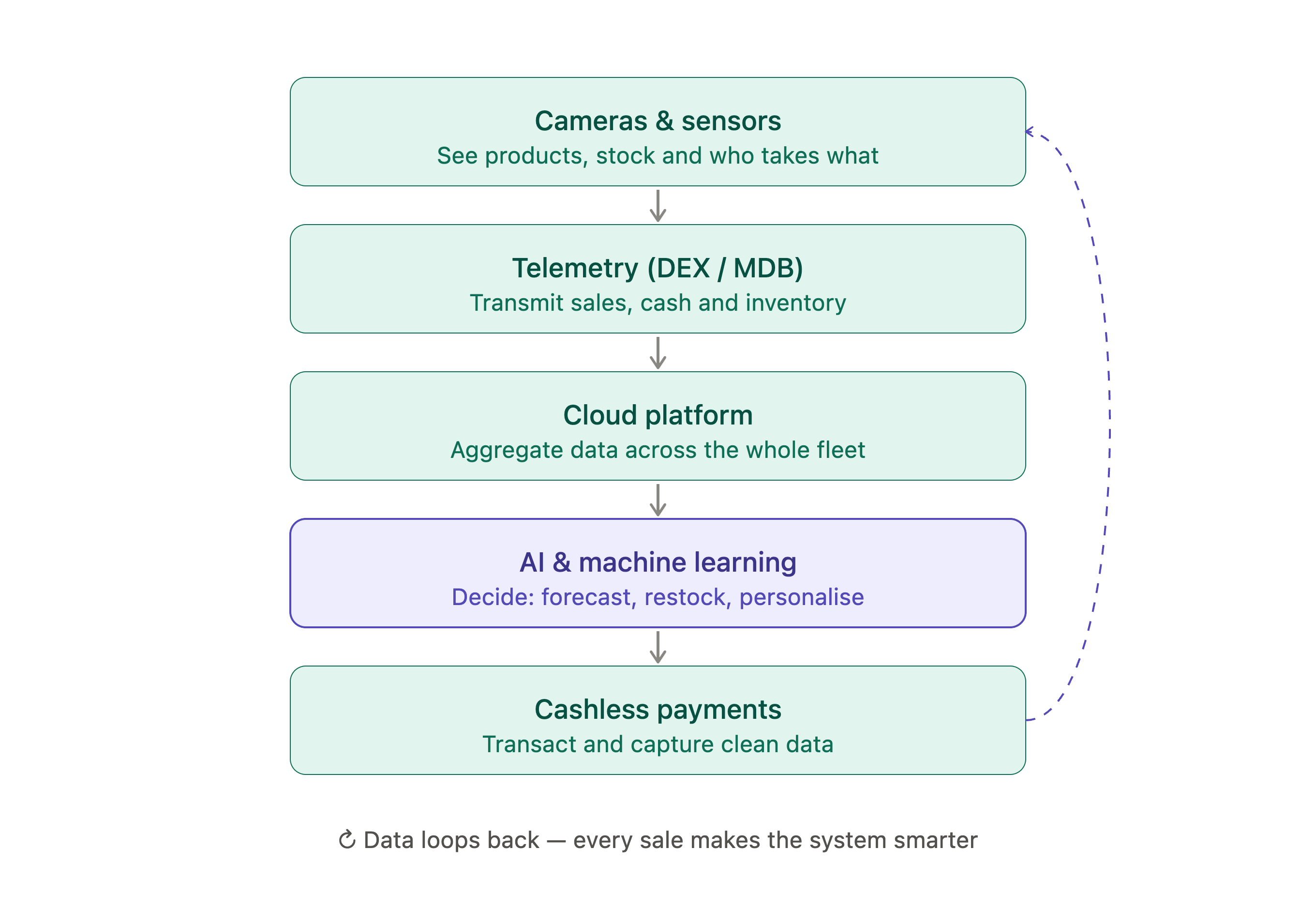
Vending telemetry is the data pipeline that carries sales, cash, and inventory information out of the machine in real time. Standards like DEX and MDB, plus telemetry providers, feed this data to the cloud. Without reliable telemetry, the AI layer has nothing to learn from—so telemetry is the foundation, not an add-on.
5. Cloud connectivity
A cloud platform aggregates data from every machine in a fleet, runs the analytics, and pushes insights back to operators through dashboards and mobile apps. Cloud connectivity is what turns one clever machine into a manageable network of them—and it’s where vending management software lives.
6. Cashless payments
Modern AI units accept cashless vending in every common form: tap-to-pay cards, mobile wallets, QR codes, and app-based payment. This isn’t just convenience—cashless transactions generate the clean, itemized data the AI relies on, and they typically lift average transaction values versus coin-only machines.
The stack in one sentence: Cameras and sensors see, telemetry transmits, the cloud aggregates, AI decides, and cashless payments transact—all in a loop that improves with every sale.
Key Features of AI Vending Machines
The most capable AI units share a common feature set:
- Camera-based product recognition (no barcodes or coils required for many designs)
- Grab-and-go / frictionless checkout options
- Real-time inventory tracking with low-stock and out-of-stock alerts
- Demand forecasting and automated restock recommendations
- Dynamic merchandising—screen-based promotions, upsells, and recommendations
- Remote monitoring and diagnostics, including predictive maintenance alerts
- Multiple cashless payment methods
- Cloud dashboards and mobile management for the whole fleet
- Loss-prevention analytics flagging anomalies and shrinkage
Benefits for Operators and Businesses
Lower operating costs
By forecasting demand and reporting stock in real time, AI machines cut wasted service trips and reduce both stockouts and spoilage. Operators visit machines when there’s a reason to, not on a fixed schedule.
Higher sales per machine
Better product mix, screen-based merchandising, and frictionless cashless checkout tend to raise both conversion and average transaction value.
Less shrinkage and waste
Vision and weight sensors make theft harder and easier to detect, while temperature monitoring and demand forecasting protect perishable stock.
Better data and decisions
Itemized, real-time data across a fleet reveals which locations, products, and price points actually perform—turning guesswork into evidence.
A modern customer experience
Touchscreens, recommendations, and tap-to-pay meet the expectations of customers used to app-based, cashless convenience.
Where the ROI really comes from: For most operators the biggest savings aren’t from the AI features themselves—they’re from the route efficiency and reduced waste that real-time data enables. The machine selling more is a bonus; the operation running leaner is the main event.
Industries Using AI Vending Machines
AI and unattended retail are spreading well beyond snacks and soda:
- Offices and corporate campuses — fresh-food coolers and micro-market-style setups for employees
- Gyms and fitness centers — supplements, drinks, and grab-and-go snacks
- Hospitals and clinics — 24/7 access to food, PPE, and supplies
- Universities and schools — high-traffic, cashless-first convenience
- Hotels and hospitality — premium grab-and-go and amenity vending
- Transit hubs (airports, stations) — electronics, essentials, and food for travelers
- Manufacturing and warehouses — industrial supply and PPE dispensing with usage tracking
- Retail and convenience — automated stores and smart coolers extending hours without staff
How Much Do AI Vending Machines Cost?
Note: The figures below are illustrative ranges to frame budgeting, not quotes. Pricing varies widely by hardware, software, and region—confirm current numbers with vendors before deciding.
AI vending economics have three components:
- Hardware — AI-enabled machines and smart coolers typically cost more than traditional units because of cameras, sensors, screens, and onboard computing. Expect a meaningful premium over a standard snack or drink machine, with fresh-food and grab-and-go units at the higher end.
- Software and connectivity — usually a monthly subscription for the management platform, telemetry, and payment processing, often priced per machine. This is where vending management software and telemetry fees live.
- Payment processing — transaction fees on cashless payments.
Thinking about ROI
The return comes from four levers, and you can estimate each for your own operation:
- Fewer service visits (fuel, labor, time) from demand-based restocking
- Less spoilage and fewer stockouts from real-time inventory and forecasting
- Higher revenue per machine from better merchandising and cashless lift
- Lower shrinkage from vision-based loss prevention
A practical way to evaluate a purchase: estimate your current monthly cost-to-serve per machine and your stockout/spoilage losses, then model how much real-time data could cut them.
A useful rule of thumb: AI hardware rarely pays for itself on novelty. It pays off when it’s deployed in high-traffic locations where the volume justifies the premium and the data savings compound across a route.
Real-World Examples of AI and Unattended Retail
AI-driven unattended retail already exists in several recognizable forms:
- Smart fresh-food fridges in offices and gyms that let users open a door, take an item, and get charged automatically via camera and sensor recognition.
- Cashierless micro-markets and automated stores in airports, campuses, and apartment buildings, where customers shop a small unattended space and pay on exit.
- Fresh-food vending brands (such as salad and meal vending concepts) that use connected machines and refrigeration monitoring to sell perishable food safely at scale.
- Smart coolers with sensor-equipped doors that track what’s removed and update inventory in real time.
AI Vending Machines vs. Smart Vending Machines
This is the question most buyers ask, so let’s make it concrete. Smart vending is a prerequisite for AI vending—every AI machine is “smart,” but not every smart machine is “AI.”
Capability | Traditional | Smart Vending | AI Vending |
|---|---|---|---|
Dispenses on payment | ✅ | ✅ | ✅ |
Cashless payments | Sometimes | ✅ | ✅ |
Telemetry / remote data | ❌ | ✅ | ✅ |
Remote monitoring & alerts | ❌ | ✅ | ✅ |
Real-time inventory | ❌ | ✅ | ✅ |
Computer-vision product recognition | ❌ | Rare | ✅ |
Grab-and-go / frictionless checkout | ❌ | ❌ | ✅ |
Demand forecasting | ❌ | Basic | ✅ (predictive) |
Automated merchandising / personalization | ❌ | ❌ | ✅ |
Predictive maintenance | ❌ | Limited | ✅ |
Acts on data automatically | ❌ | ❌ | ✅ |
The takeaway: if you mainly need visibility and efficiency, a well-run smart vending setup with strong telemetry and remote monitoring may deliver most of the value at a lower cost. AI vending earns its premium when you need the machine to recognize, predict, and act—especially for fresh food, grab-and-go, or high-traffic automated retail.
Challenges and Limitations
AI vending is powerful but not effortless. Plan for these:
- Higher upfront cost and a longer payback period than standard machines.
- Connectivity dependence — AI features degrade or stop without reliable internet; rural or steel-walled locations can be a problem.
- Computer-vision accuracy — recognition can struggle with similar-looking items, poor lighting, or unusual customer behavior, occasionally causing mischarges.
- Maintenance complexity — more components (cameras, sensors, screens) mean more potential points of failure and more specialized servicing.
- Data privacy and compliance — camera-equipped machines raise legitimate privacy questions; be transparent with customers and follow local regulations.
- Integration — getting AI hardware, telemetry, payments, and your vending management software to work together cleanly takes planning.
Don’t skip the basics: AI can’t fix a weak operation. If your telemetry is unreliable or your data is messy, the AI layer will simply automate bad inputs. Solid telemetry and clean data come first.
Future Trends in AI Vending
Where the category is heading:
- Deeper personalization — machines tailoring offers to time of day, location, and (with consent) returning customers.
- Predictive everything — maintenance, restocking, and even pricing moving from reactive to predictive.
- Frictionless as the default — grab-and-go and cashierless designs expanding from premium pilots to mainstream placements.
- Energy and sustainability — smarter cooling and demand-based operation reducing energy use and food waste.
- Tighter software ecosystems — payments, telemetry, and management software converging into unified platforms, reducing the integration burden on operators.
- Edge AI — more processing on the machine itself, so units stay smart even with patchy connectivity.
Frequently Asked Questions
1. What is an AI vending machine?
An unattended retail unit that uses artificial intelligence—mainly computer vision and machine learning—to recognize products, track inventory, forecast demand, personalize selling, and automate maintenance and merchandising decisions.
2. How is an AI vending machine different from a smart vending machine?
A smart vending machine reports data (telemetry, remote monitoring, real-time inventory). An AI vending machine interprets that data and acts on it—recognizing items, predicting demand, and automating decisions. Every AI machine is smart; not every smart machine is AI.
3. How do AI vending machines recognize products?
Through computer-vision cameras and machine-learning models, often combined with weight sensors, so items can be identified and charged without barcodes or traditional coils.
4. Do AI vending machines need internet access?
Yes. Cloud connectivity and telemetry are core to how they work. Some units use edge AI to keep basic functions running during outages, but most features depend on a stable connection.
5. What payment methods do AI vending machines accept?
Typically all major cashless options—contactless cards, mobile wallets, QR codes, and app payments—often alongside traditional payment for backward compatibility.
6. Are AI vending machines worth the cost?
They can be, in the right setting. The ROI comes from fewer service trips, less spoilage and shrinkage, and higher sales per machine. They pay off best in high-traffic locations where volume justifies the hardware premium.
7. What industries use AI vending machines?
Offices, gyms, hospitals, universities, hotels, transit hubs, manufacturing/warehouses, and retail—anywhere 24/7, cashless, low-staff convenience adds value.
8. Can AI vending machines reduce theft?
Yes. Vision and weight sensors make unauthorized removal harder to complete and easier to detect, and anomaly-detection software flags suspicious activity.
9. What is vending telemetry, and why does it matter for AI?
Telemetry is the real-time data feed (sales, cash, inventory) coming out of a machine, using standards like DEX and MDB. It’s the foundation AI learns from—no telemetry, no useful AI.
10. Do I need special software to run AI vending machines?
Yes—a cloud-based vending management platform aggregates the data, runs analytics, and lets you manage the fleet remotely. The software is as important as the hardware.
11. Can I add AI features to my existing machines?
Often partially. You can usually add cashless payments and telemetry to upgrade traditional machines to “smart,” but full computer-vision AI typically requires purpose-built hardware.
12. Are AI vending machines secure and privacy-compliant?
They can be, but camera-equipped units raise privacy considerations. Choose vendors with clear data practices, disclose camera use to customers, and follow local privacy laws.
13. How much do AI vending machines cost?
More than traditional machines, plus a monthly software/telemetry subscription and payment-processing fees. Exact pricing varies widely by hardware and provider—get current quotes before budgeting.
14. What’s the difference between AI vending and a cashierless store?
They’re points on the same spectrum. An AI vending machine is a single enclosed unit; a cashierless/automated store applies the same vision-and-sensor technology to a small walk-in space.
15. How do I get started with AI or smart vending?
Start with reliable telemetry, cashless payments, and solid vending management software on your existing fleet. That foundation captures the data and most of the efficiency gains—and prepares you to adopt AI hardware where the volume justifies it.
Conclusion
AI vending machines represent the next step in unattended retail: machines that don’t just sell and report, but see, predict, and act. For operators, the appeal isn’t the technology for its own sake—it’s leaner routes, less waste, lower shrinkage, and a modern, cashless customer experience.
That said, AI hardware is an investment, and it delivers most where traffic is high and the data foundation is strong. For many operators, the smartest first move is to get telemetry, remote monitoring, and cashless payments working flawlessly across the current fleet—then layer AI in where the numbers support it.
Want more vending business tips?
Subscribe to our free 2-week email course and learn how to start a successful vending business.