When most people hear “vending machine,” they still picture the familiar rows of chips, candy and cold drinks. The products have changed over the years, and the technology certainly has, but the basic image remains surprisingly persistent. Meanwhile, vending machines have quietly found their way into places where a can of soda would be almost beside the point.
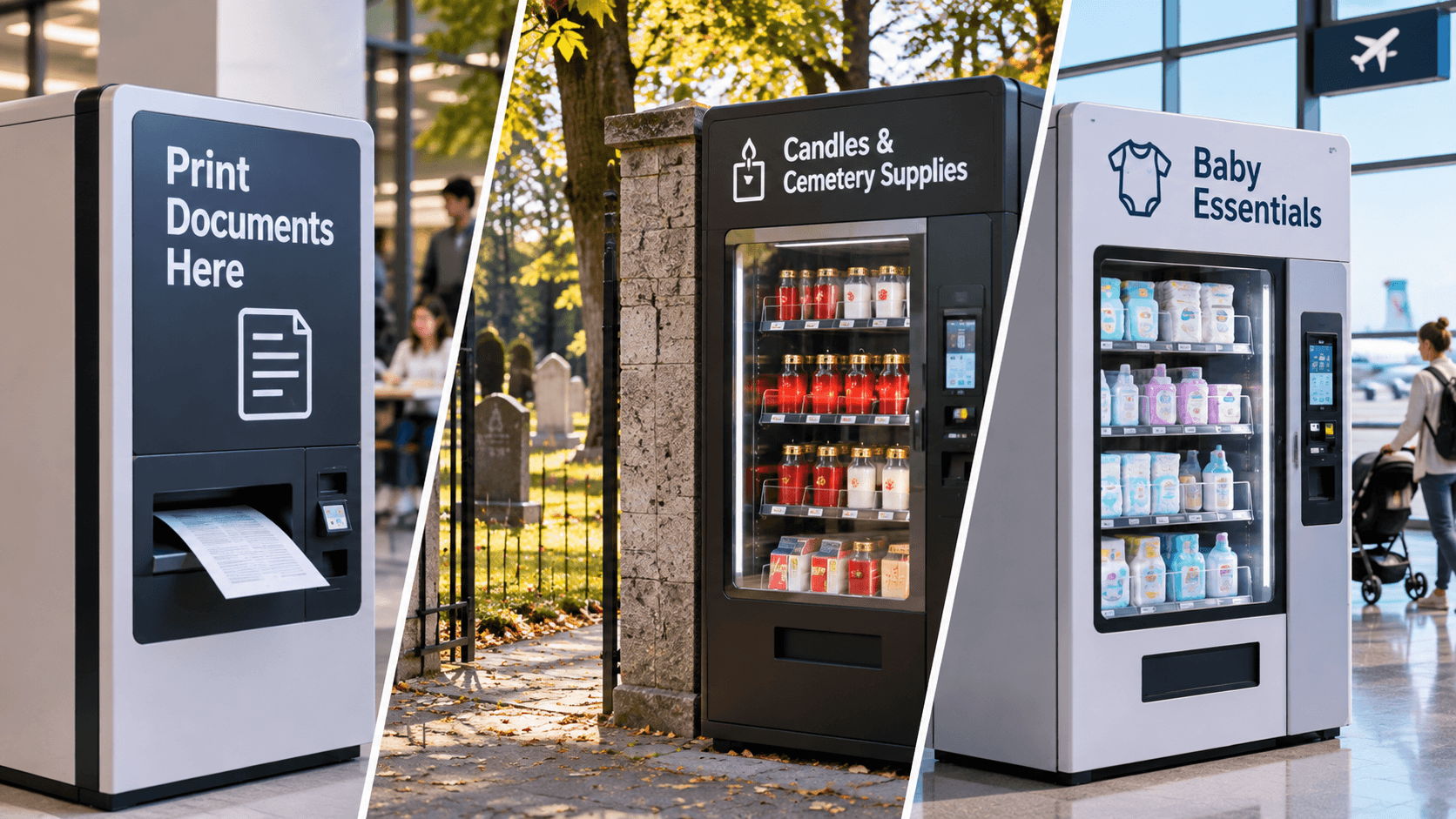
There are machines that print documents in university buildings. Machines outside cemeteries selling candles and matches. Machines in airports stocked with diapers, wipes and formula.
At first glance, these might simply look like unusual vending ideas. But there is something more interesting connecting them. None of these machines is trying to persuade someone to make an impulse purchase. They are there because, at a particular moment and in a particular place, somebody realizes: I need this now.
And that may be one of the more interesting directions for unattended retail.
The printer for shopping malls that doesn’t need a print shop
Printing a document is one of those tasks that seems trivial until you actually need to do it away from home.
Perhaps you’re a student who needs to hand in an assignment. You’re staying in a dormitory without a printer. You need a signed document before a meeting. The file is sitting on your phone, the nearest print shop is closed, and suddenly producing three sheets of paper has become remarkably inconvenient.
Self-service printing kiosks solve that very specific problem.
Companies such as QwikPrint in India have developed kiosks where users scan a QR code, upload a document from their phone or laptop, choose their print settings, pay and collect the printed pages directly from the machine. Similar concepts exist elsewhere: Printbox operates self-service printing kiosks in European locations including universities, libraries, student dormitories, shopping centers and public institutions.
It is vending, although not in the way we usually think about it. There is no packaged product waiting behind glass. What is being automated is a service that would traditionally require a printer at home or another person behind a counter.
More importantly, the locations make sense. A printing kiosk in the middle of an empty parking lot would be a strange business. Put the same machine in a university residence or library, where hundreds of people regularly need access to a printer, and suddenly it becomes much less strange.
The unusual part isn’t really the machine. It’s recognizing that printing can be treated as an unattended, on-demand purchase.
Vending machines at the cemetery
The second example is quite different.
In parts of Europe, vending machines can be found at or near cemeteries selling grave candles, memorial lights, matches and related items. German vending manufacturer Hensing, for example, produces machines specifically for this purpose, designed for outdoor use and around-the-clock access. Unusual vending has also appeared in more ceremonial settings: in 2013, champagne machines in london caught on, dispensing bottles and, of course, serving flutes.
There is something almost counterintuitive about putting a vending machine in a cemetery. We associate vending with convenience, speed and commercial spaces; a cemetery is none of those things.
But consider the situation from the visitor’s perspective.
Someone arrives after work to visit a grave and realizes they haven’t brought a candle. Perhaps it’s Sunday and nearby shops are closed. Perhaps they need matches. Perhaps they simply hadn’t planned the visit. Driving somewhere else to find a florist or shop and then returning turns a very small need into an unnecessary journey.
A machine at the cemetery entrance solves it without requiring a staffed store to operate beside a location where demand may be intermittent.
It’s also a good example of why vending doesn’t necessarily require huge foot traffic. A cemetery obviously isn’t an airport or shopping mall. But the people who do visit have a very specific reason for being there, and some of them will predictably need the same small group of products.
That’s a different way of thinking about a vending location: not How many people walk past here? but What might the people who come here suddenly need?
The airport and train stations diaper emergency
Anyone who has travelled with a baby probably doesn’t need much explanation for the third one.
Airports contain shops selling an enormous variety of things, yet something as basic as the right size diaper can be surprisingly difficult to find when you need one. And unlike forgetting headphones or a phone charger, a diaper emergency doesn’t leave much room for postponement.
That’s the problem behind baby-supply vending machines.
Diaper Concierge has developed compact vending machines stocked with essentials such as diapers, wipes and formula. The idea came after its founder found herself away from home with her baby and one diaper short of what she needed. The machines are intended for exactly those situations, particularly in high-traffic places where parents may suddenly discover something important is missing.
And the concept isn’t limited to one company. Sephora launched airport vending machines for beauty products in 2010. Uniqlo launched clothing vending machines in the US in 2017, using them to sell basics packed in cans and boxes to customers in transit in airports, shopping malls and other locations across multiple states, with different sizes available for travelers who needed a quick replacement. Baby-essential vending machines have appeared in airports with products ranging from diapers and wipes to pacifiers, bottles and spare clothing.
Again, the product itself isn’t unusual. You can buy diapers almost anywhere.
What makes the vending machine interesting is where they are being sold.
A parent standing in a supermarket has plenty of options. A parent who has already passed airport security, has a flight boarding shortly and has just used the last diaper in the bag has very few. The value of the machine comes from being there at precisely that moment.
Maybe the product isn’t where the idea starts
These three machines have almost nothing in common on the surface.
One prints paper. One sells memorial candles. One dispenses baby supplies.
But the thinking behind them is remarkably similar.
Someone looked at a place and noticed a recurring inconvenience.
People in universities occasionally need to print something when they don’t have access to a printer. Cemetery visitors occasionally arrive without a candle. Parents in airports occasionally run out of something they can’t comfortably wait several hours to replace.
Then someone put the solution where the problem happens.
That distinction matters because vending ideas are often approached from the opposite direction: What could I put in a vending machine? In 2014, Istanbul introduced machines that dispense food and water for stray animals where that need already exists. Art vending machines apply the same logic by dispensing miniature original works from independent artists in places where people are already primed to browse.
Maybe a better question is: Where are people regularly getting stuck? In New York, Bikestock kiosks dispense inner tubes and other bike-repair supplies 24/7 where cyclists need immediate help. Fishing bait vending machines do the same for anglers who need gear outside normal store hours.
Once you start looking at locations that way, the possibilities become broader than snacks, drinks or even physical products, with some machines even dispensing free short stories to commuters. Some machines even sell gold, with Gold to Go updating the price every 10 minutes so buyers can purchase a bar or coin when the price is right, and high-end vending extends to luxury gift machines in Dubai selling items such as perfumes and lingerie. In Singapore, luxury car vending goes even further by showcasing 60 cars in a format tailored to buyers who want speed and automation. A useful vending concept doesn’t necessarily need to be bizarre or revolutionary. It needs to remove enough friction from a small but recurring problem that someone is willing to pay for the solution.
The best location might therefore not be the place with the largest crowd. It might be the place where the right person has very few alternatives. Other machines solve hunger quickly too, with complete meals ranging from hot ramen to pizza vending machines that can cook a fresh pizza in three minutes. Cupcake ATMs dispense fresh cupcakes 24 hours a day. In Paris, baguette vending machines sell partly baked baguettes for convenient fresh bread. Crab vending machines dispensing live crabs began in 2010 in China.
And sometimes that turns out to be a university hallway, an airport restroom — or the entrance to a cemetery.
Running vending machines of your own? VendSoft helps operators manage inventory, plan routes, track sales and understand how their machines are performing from one place. Start a 14-day free trial with no credit card or payment information required.
Want more vending business tips?
Subscribe to our free 2-week email course and learn how to start a successful vending business.